Saturday, April 25, 2009
The Power of Healing: Remembering our Babaylan Spirit
Human beings are not born violent: Associate Professor Leny Mendoza-Strobel
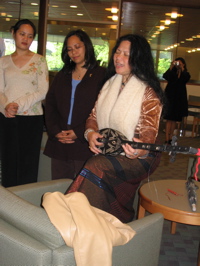
SAN PEDRO—"Perhaps if women had never lost parity with men and we live in a society that honors both genders equally, we wouldn’t even need an International Women’s Day," declared Dr. Leny Mendoza Strobel, an Associate Professor of American Multicultural Studies at Sonoma State University, and a cultural and community advocate.
The celebration of International Women’s Day, which began in 1911 and celebrated in 63 countries and 982 events this year, is a "gesture of multiculturalism in its conservative form," according to Dr. Strobel, who spoke at the Men Reading Women’s Writings luncheon held at the Ports of Call Restaurant in San Pedro on Saturday, March 28. Her speech was entitled The Power of Healing: Remembering our Babaylan Spirit.
"Human beings are not born violent, do you agree?" she began. "We now have access to accounts that tell us of prehistoric huntergatherer societies that lived in balance with nature and harmony with each other and with other species. They had conflicts, but they did not have war."
Dr. Strobel said that even today, according to Filipino author Katrin de Guia, in the Philippine island of Palawan, there are still indigenous peoples that do not have a word for war in their language. "When developers began to encroach on their ancestral domains, they mainly avoided the conflict by moving deeper into the forest."
Historians write that matriarchal societies ended at the beginning of the agricultural era 10,000 years ago. That era also marked the beginning of patriarchal civilizations. "Matriarchal societies," says Dr. Strobel, "are non-hierarchical, egalitarian and deemed the relationship to the universe and all species as sacred. With the rise and evolution of patriarchy, these feminine values and energies were repressed and exiled into the narrow spaces of expression under the control of patriarchal institutions and systems."
Philippine Society in general is under-guarded by an egalitarian, lateral kinship system, according to a talk by Filipino professor Jaime Veneracion, at a lecture he delivered to a group of Fullbright scholars that included Dr. Strobel. "This is the reason," says Dr. Strobel, "why we have a difficult time adjusting to the requirements of modernity because underneath all these modern impositions is a bilateral egalitarian system."
Dr. Strobel said she recently had a discussion with her Fil-Am classes At Sonoma State University in which they talked about the values of "kapwa" (fellow humans) and "Bathala na" (God’s will), the value of "loob" (inner self) and "dangal" (honor) and "pakikiramdam" (sensitivity). "Many of the white students remarked how beautiful these values are, and that they would like to live their lives being more in tune to those values," Dr. Strobel revealed. "Our modern lives dismember and fragment our lives by exiling our feminine or female energies in the bedroom and in the home and the service of men’s needs," Dr. Strobel asserts. "Men are dismembered by cultural values that tell them that they must not cry or show emotions, or that the only way to survive and make it in the world is through aggressive competition," she adds.
She said that the psychology of "kapwa" (self) is geared towards the "babaylan" (ancient healer/shaman) practice that each human embodies male and female energy. "That’s what makes a person whole," said Dr. Strobel.
Linda Nietes, owner of Philippines Expressions Bookshop, which organized the event, thanked the men for coming and for reading stories and poems written by Filipino women. The readers were Robert J. Little, Jr. (Linda Nietes’ husband); who read Love ‘Em, Leave ‘Em and Speak Up Woman!, A Dalaga’s Debut, from the book Twenty-Five Chickens and Pig for Bride, read by Stephen Adamu; To the Man Who Thinks He’s in the Market, poetry by Rowena Penaflor Festin and In the Name of the Mother:100 Years of Philippine Feminist Poetry, 1889-1989 by Lilia Quindoza Santiago, read by Robert J. Little, Jr., The Legend of Lola Amonita, poetry by Elvira S. Mabanglo, and Silence, a story by Marianne Villanueva, read by Craig Diamond; and Beauty and the Brit by Joselle Concio Harkin, from the book Speak Up, read by Steve Austin, and Fruit Stall from the book, The Kissing: A Collection of Short Stories by Melinda Bobis, read by Steven de la Vega.
"Men are present because in our last event last year, we had made it an all-woman activity. Now we thank the men for coming," Nietes said. "This is an advocacy that we women cannot do alone…; to be able to highlight the fact that men and women are partners in their journey in this life."
Published on April 4, 2009 in Asian Journal Los Angeles, p. A3, accessed 4/24/2009.
Contributed by Leny Mendoza-Strobel
Kapwacon '09 - Save the Date
The conference will focus on the work of educators to better serve the diverse nature of today’s student population – Filipin@ youth, people of color, and similarly marginalized persons to transcend the effects of colonization and go beyond the basics of identity politics, to develop survival strategies, foster healing, and to build bridges and nurture community.
Through lectures, panels, roundtables, symposia, workshops, exhibits and performances, we will specifically explore roles and perspectives at the intersections of the Global, Local, and Personal levels.
See the Kapwacon 09 blog for details.
The Chieftain, The Artisan, and the Healer
"Through the use of myths and legends, old dictionaries, friar accounts and other historical and archaelogical records, the group, led by Dr. Zeus A. Salazar,* opened the way to access the ancient barangay's life form- it's economic and socio-political organization, including their non-material elements necessary for their existence."
ROOTS & PRESENCE, The Baybaylan Historico-Cultural Context, p. 22-23 in CENTENNIAL CROSSINGS, Readings on Babaylan Feminism in the Philippines, Edited by Fe B. Mangahas & Jenny R. Llaguno.
"Salazar* identified three figure of authority in the barangay: the datu, panday and babaylan. The datu, who was the local chieftain, took charge of the economic and political organization of the barangay. The importance of specialists with particular skills was emphasized by the bestowal of the title 'panday', in recognition of mastery of an art, an applied science. Skills in various materials were specified: panday-ginto (goldsmith), panday-bakal (blacksmith) or panday-anluwagi (builder-carpenter) . The babaylan, predominantly women (men had to be like women to perform this societal function), was the "specialist in the fields of culture, religion, medicine and all kinds of theoretical knowledge about the phenomenon of nature....a pro-scientist. .." Salazar later added a fourth figure - the bayani or bagani (chief warrior or hero) who took card of the maintenance of law and order, peace and stability of the barangay.
"The World of the Babaylan
What kind of physical and social world could possibly produce women with leadership qualities equal to men as datu & panday?"
GINTO, History wrought in Gold by Ramon Villegas.
* DATU, PANDAY & BABAYLAN "Bagong Kasaysayan" by Zeus A. Salazar & Mary Jane B. Rodriguez, UP Journal Series (1999).
Contributed by Mary Ann Ubaldo, Urduja Filipino Jewelry
Sunday, April 05, 2009
Artist Expressions - Urduja Custom Jewelry
Mary Ann Ubaldo writes:
I am an artist that deeply relates to our Filipino culture. It is a decolonization process(pagbabalik loob) for me of reconnecting with the past to get a better understanding of the present and be able to envision the future.
Going through this process strengthens the cultural connection to the Filipino indigenous culture, ideology as a source of grounding.
In this way, it promotes cultural and spiritual connection making it possible for us to identify with one's people and history despite personal, generational, education, economic classes and other forms of differences.
Language and the way of writing are foundations of one's culture. By using Baybayin/Alibata in my art it is a deeper search of our identity and understanding how the loss of language, ancient scripts affects our Filipino identity, that the Filipino culture is the soul of our people, a connection to our folk soul.
I could really say, I am on a LAKARAN, that inspired me to do it, a spiritual journey/ pilgrimage, towards understanding a little bit better our spiritual heritage. It is a pilgrimage back to my Filipino cultural roots, a search going back to our KATAALAN.
I see the power of art as a tool to educate and raise consciousness about our indigenous roots. I am reinventing who we are, making sense of what is it to be a Filipino/Filipina, not defined by colonizers.
I believe, there is an inner guiding spirit which I identify as my MUTYA, the spiritual force (diwa/soul) of Inang Bayan (Motherland), that leads me in my art. I am guided by BATHALA & our ancestors.
Through her different lines of jewelry, Mary Ann expresses the intricate relationship between the artist and her beliefs, providing a tangible method for others to connect with the deepness of the babaylan world-view.
Defining Kapwa
(pronoun) kindred, both; fellow-being, equally (applied to one of a pair) - Kapwa dot Com
...the tendency to see the world with all its beings, both human and lower forms, as a holistic system where everything operates interdependently and inter-relatedly... It is a system where harmony with other people and the environment is a much-needed trait. - Henry F. Funtecha, Ph.D., The News Today, 7/4/2008
...the Tagalog word for "shared identity" or "brotherhood." - DavisWiki
One of the most important features of the Indigenous Knowledge Systems and Practices (IKSP) is the tendency to see the world with all its beings as a holistic system where things operate interdependently. Harmony with other people and the environment is a much-needed trait today in our shrinking global village. This orientation is called "kapwa"—the shared self — in the Filipino traditional value system, as expounded by Sikolohiyang Pilipino (SP). - Leny Strobel, 1/27/2008
One of the most difficult questions and tasks about dismantling privilege is this requirement to shift our understanding of the Self from the "I" to "We/kapwa." In the latter, we (privileged Americans) must begin to know and feel deeply that our affluent lifestyles have a social cost and a social burden that is carried by the poor of the world and the Earth. - Leny Strobel, 1/4/2008
I think the primary action of decolonization for me is this realization that I am not the artifact called 'Filipina,' but a Filipina - one who interacts and is constantly remade as a Filipina with every interaction, every relationship forged, every action I make which ties me to my heritage. Being Filipina isn't defined only by what I do as an individual, but by the living, breathingness of Kapwa that takes into account my environment, my choices, the choices of others, my fears and triumphs, all at the same time, all in constant motion. Rebecca Mabanglo-Mayor
“Kapwa”—a Filipino cultural concept of interconnectedness whereby other people are not “others” but part of what one is. (from the opening page; emphasis in original). - Eileen Tabios, Blind Chatelaine's Keys
Shared identity; fellow being; neighbor; the shared, "including" the Self. - Katrin de Guia, p. 376 Kapwa: The Self in the Other (Anvil Publishing, Pasig City, 2005)
Thursday, March 26, 2009
April 17-18, 2010
Sonoma State University
CONCEPT PAPER FOR A BABAYLAN GATHERING
THEME: FILIPINO INDIGENOUS KNOWLEDGE SYSTEMS AND PRACTICES: THEIR RELEVANCE IN AN AGE OF GLOBALIZATION (note: this was the theme of the Kapwa 2 Conference in Iloilo in 2008; while we want to focus on Babaylan, we would frame it within IKSP).
RATIONALE AND VISION: We believe in the power of the Indigenous Soul and the Indigenous World View, as embodied by primary babaylans and contemporary babaylan/culture-bearers, to provide a narrative that restores a sense of wholeness, beauty, and integrity to our pagkaPilipino. In a world that aches for peace, justice, and healing from the violent effects of colonial and imperial histories, our Babaylan and our indigenous knowledge systems and practices offer a path to re-membering and remembering the sacredness, strength, beauty, and the creativity of our Filipino Loob.
Those who have done the deep work of reconnecting with the spirit of the Babaylan would like to share this experience with our communities. We would like to reflect together and celebrate this wealth from our spiritual and cultural heritage so that it might nourish and nurture the work that we do to heal and bless, to make peace, to create justice, to teach our kin the values of Kapwa, Kagandahang Loob, Pakikiramdam, and Panagtagbo.
We live in a planet of diminishing resources. We live in a time when so many peoples on the planet are becoming disillusioned and disheartened by the narratives of empire, manic global capitalism, neoliberalism, "progress and development," as these fall short in their promise to alleviate suffering, poverty, injustice for a majority of people on the planet. Many are questioning these modern paradigms, as it's becoming apparent that the affluent lifestyles these paradigms have created for a fraction of people on the planet are not sustainable and do not sustain happiness.
There is a growing body of literature that attempts to show why modernity is failing us. These texts invite us to extend our historical perspective all the way back to Paleolithic times to learn what kinds of values and worldview allowed the earliest groups of people to live sustainably for hundreds of thousands of years. Only through a lengthened historical perspective do we begin to see the bends and turns that our ancient ancestors took to become on the one hand as "Leavers" (those who remained on the land) and on the other as "Takers" (those who would eventually become empire builders and colonizers). (Ishmael by Daniel Quinn).
We are fortunate to still have with us shamans who have access to "The World We Used to Live In" (when All was considered Sacred). (Vine DeLoria) The sacred world that includes spirits, and belief in the sacred non-hierarchical interdependent relationship of all species before it all became disenchanted and desacralized by the rise of the scientific worldview. We still have remnants of old sacred chants and oral traditions, dances, rituals, weaving, drumming and other practices that can re-connect our body, mind, and soul and experience this sacred wholeness.
In this gathering, we bring together: 1) key resource persons from the Philippines on Filipino Indigenous Knowledge Systems and Practices; 2) babaylan/culture-bearers in the US whose life work is informed by the babaylan tradition; 3) babaylan-inspired scholars who address the sub-themes in the stated vision; 4) babaylan-inspired teachers, healers, warriors, priestesses, visionaries whose life work is centered around indigenizing the Filipino self; 5) persons who recognize decolonization as a spiritual path; 6) persons who consciously work on the sycnretic integration of non-indigenous elements into Filipino spirituality; 7) persons whose creative expressions resonate with being indigenous or indio-genius.
Nurturers and Organizers: Perla Daly, Letecia Layson, Baylan Megino and Leny Strobel
Please help us in organizing the conference. We will need a lot of help with Fundraising and Sponsorships, Publicity, Housing and Accommodations, Registration, and other logistics.
Monday, February 02, 2009
Babaylan is a term identifying an indigenous Filipino religious leader, who functions as a healer, a shaman, a seer and a community "miracle-worker" (or a combination of any of those). Although the role and function of a babaylan is open to both sexes, most babaylans from the pre-hispanic era are female. Wikipedia (accessed 2/2/2009)
Who is a babaylan? The babaylans, predominantly women, were mystical women who wielded social and spiritual power in pre-colonial Philippine society before the coming of the Spanish conquerors in the 16th century. In his research on pre-colonial women, anthropologist Dr. Zeus Salazar described the babaylan as “a specialist in the fields of culture, religion, medicine and all kinds of theoretical knowledge about the phenomenon of nature.” Isis International (accessed 2/2/2009)
Wednesday, November 09, 2005
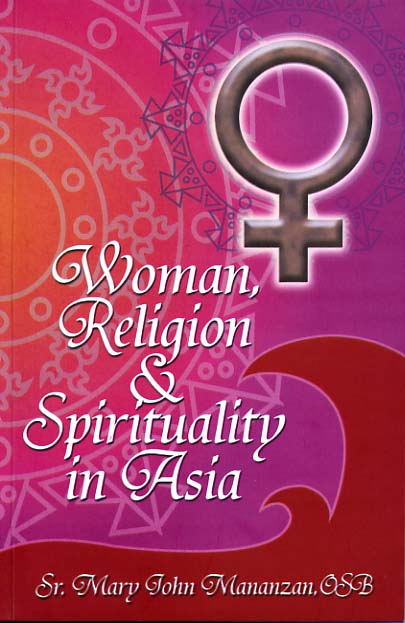
Book Feature:Women, Religion and Spirituality in Asia by Sr. Mary John Mananzan, OSB
Published 2004 by Anvil and Institute of Women's Studies
ISBN 971-27-1495-0 (bp)
ISBN 971-27-1513-2 (np)
Book Design by Arnold R. Ramos
(click image for detail)
Table of Contents
Perspectives
Chapter 1
Introduction: My Story
A Personal Perspective
Chapter 2
The Asian Feminist Theology of Liberation: A Historical Perspective
Women in Asian World Religions
Chapter 3
Asian Women and Christianity
A Feminist Theological Perspective
Chapter 4
The Basics of Hinduism
Chapter 5
Women in Hinduism
Portraits and Issues
- Portrait One: Kali-Durga
- Portrait Two: Mirabai (1948-circa 1540)
- Contemporary Interview: Madhu Khanna
- Issue Focus: Dowry Deaths
Chapter 6
The Basic Teachings of Buddhism
Chapter 7
Women in Buddhism
Portraits and Issues
- Portrait One: Tara
- Portrait Two: Yeshe Tsogyal, Tibetan Tantric Music
- Contemporary Interview: Chatsumarn Kabilsingh
- Issue Focus: Women's Ordination in Theravada Buddhism (Sri Lanka and Thailand)
Chapter 8
Basic Tenets of Islam
Chapter 9
Women in Islam
Portraits and Issues
- Portrait One: Aisha Bint Abi Bakr Siddique
- Portrait Two: Rabi'a Al-'Adawiyya of Basra
- Contemporary Interview: Norani Othman
- Issue Focus: Polygamy in the Malaysian Context
Women in Non-World Religions in Asia
Chapter 10
Women in Confucianism
Chapter 11
Women in Indigenous Religions
Chapter 12
Women in New Religions of Japan: Tentrikyo
Chapter 13
Women in Folk Religions
Chapter 14
Summary, Appraisal, Conclusion
Bibliography
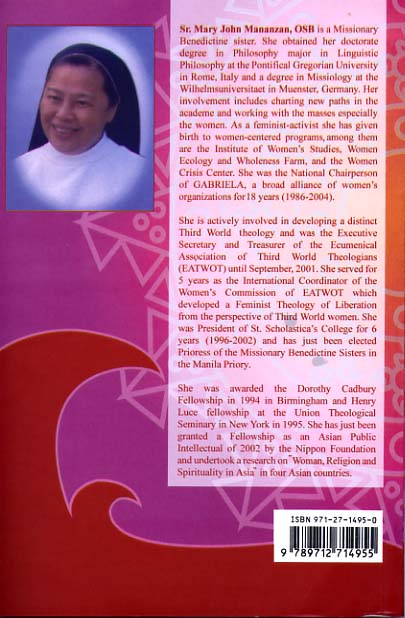
Back cover & About the Author (click image for detail)Women, Religion and Spirituality in Asia
Event in New York City:
A Roundtable Discussion with Sr. Mary John Mananzan, OSB
When:Thursday, November 10th, 6:30-8:30 pm
Location:
Barnard College, Held Auditorium (304 Barnard Hall)
3009 Broadway, btwn 116 & 120 Sts.
New York, New York
Directions:
Take the uptown 1 train to 116 St / Columbia University. Exit on the west side of Broadway. Enter through the main gate. Barnard Hall is the building directly in front of you.
Hosted by: the volunteer publishers of NewFilipina.com
Entrance: $5
Description:
Come and join Sister MJM in a presentation and discussion about how the scriptures and writings of religions speak of women in Asia and what is the impact of institutional religions on these women. And also includes how women theologians are trying to change what is oppressive while enhancing that which contributes to the full humanity of women. Will also include some discussion on spiritual activism, decolonization and what babaylanism means to Filipino women leaders today. (Babaylan is the visayan word for the village priestess of Philippine pre-colonial times).
About Our Guest Speaker:
Sr. Mary John Mananzan, OSB is a Missionary Benedictine sister. She obtained her doctorate degree in Philosophy major in Linguistic Philosophy at the Pontifical Gregorian University in Rome, Italy and a degree in Missiology at the Wilhelmsuniversitaet in Muenster, Germany. Her involvement includes charting new paths in the academe and working with the masses especially the women. As a feminist-activist she has given birth to women-centered programs among them are the Institute of Women's Studies, Women Ecology and Wholeness Farm, and the Women Crisis Center.
She was the National Chairperson of GABRIELA, a broad alliance of women's organization for 18 years.(1986-2004) She is actively involved in developing a distinct Third World Theology and was the Executive Secretary and Treasurer of the Ecumenical Association of Third World Theologians (EATWOT) until September, 2001. She served for 5 years as the International Coordinator of the Women's Commision of EATWOT which developed a Feminist Theology of Liberation from the perspective of Third World women. She was President of St. Scholastica's College for 6 years (1996-2002) and has just been elected Prioress of the Missionary Benedictine Sisters in the Manila Priory.
Today, Sister is now the Mother Prioress, St. Scholastica's Priory, the Director of Institute of Women's Studies, St. Scholastica's College, Manila, Philippines, Lifetime Honorary Chairperson of GABRIELA, Philippines She was awarded the Dorothy Cadbury Fellowship in 1994 in Birmingham and Henry Luce Fellowship at the Union Theological Seminary in New York in 1995. She has just been granted a Fellowship as an Asian Public Intellectual of 2002 by the Nippon Foundation and undertook a research on Woman, Religion and Spirituality in Asia in four Asian countries. Her book entitled Woman, Religion and Spirituality was published by Anvil and was launched during the International Book Fair at the World Trade Center in Manila on August 15, 2004.
Contact:
Perla Daly
Founder, NewFilipina, Inc., www.newfilipina.com
Chairwoman, FAWN2005, www.fawn2005.com
cel 203.770.7530, studio 860.350.2535
Wednesday, August 10, 2005
From the Babaylan Symposium, St. Scholastica's College, Manila, July 22, 2005

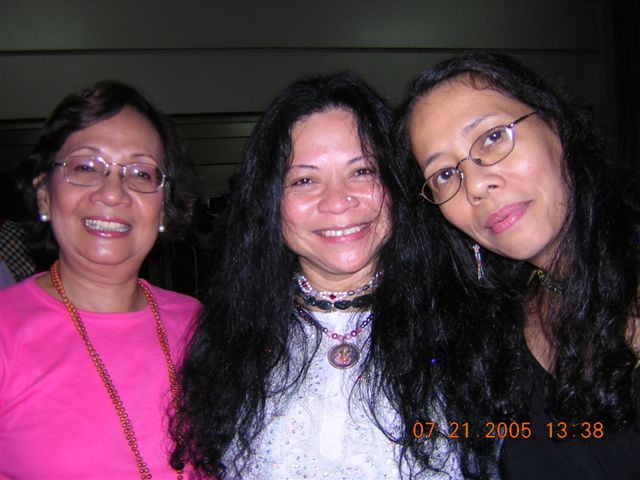
above: Evelie and Agnes (on the right); I think the woman in pink is Ms Atienza...from a women's NGO (click image for large version)

above: with Senator Leticia Shanani (in native dress); Grace Nono in purple, and Sister Datung (nun)(click image for large version)

above: With Carolyn Brewer and Fe Mangahas and Sister Mary John (click image for large version)
Tuesday, August 09, 2005
You can now download the Keynote Address of Agnes N. Miclat-Cacayan from the Babaylan Symposium held at St. Scholastica's College, Manila, on July 22, 2005. Thank you Agnes for sharing this with all of us online!
>>Click here to download.
Sunday, June 12, 2005
Mga Kathang Babaylan: Five Book Showcase
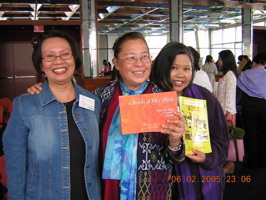
Readings and Book Signings with launching of Leny Strobel's A Book of Her Own, Words and Images to Honor the Babaylan.
Readings by:
• Marivi Soliven Blanco (Speak Up, Woman)
• Edwina Bergano, Veronica, Salcedo, Joan May Cordova (FANHS' In Our Auntie' Words: The Filipino Spirit of Hampton Roads)
• Patria Rivera (Puti/White)
• Janet Stickmon (Crushing Soft Rubies: A Memoir).
Moderator: Bino A. Realuyo, (Author of Umbrella )
L to R: Janet Stickmon, Edwina Bergano, Patria Rivera, Marivi S, Blanco, Bino Realuyo(facilitator), Joan May Cordova, Leny Strobel. (not in picture: Veronica Salcedo)
Philippine Expressions Bookshop
The Mail Order Bookshop Dedicated to Filipino Americans in Search of their roots.
2114 Trudie Drive, Ranchos Palos Verdes, CA 90275-2005
telephone 310.514.9139, fax 310.514.3485, Email: lindanietes@sbcglobal.net
Saturday, June 11, 2005
Babaylan Spirit Retreat
Held the day before the FAWN2005 conference, we gathered together to create sacred space and time. To center and reconnect ourselves with higher purpose and our indigenous spiritual heritage. And also for focusing the energy and intentions of the next days' gathering of Filipino women leaders from around the world. This was a special opportunity to come together to pray, meditate and contemplate on the many levels of where we come from, who are we, what do we want for not only ourselves but also for our families, our communities, Filipinos and humanity.
Click here for the complete gallery

L to R: Potri, Baylan, Rowena, Letty, Joanie, Evelie.

L to R: Ann, Letty, Potri, Baylan, Rowena, Evelie .

Friday, June 10, 2005
Spirit of the Babaylan Exhibit
Coordinated by Marv Velando. Presented by FAWN2005
Click here for more details.
Spirit of the Babaylan: Open Art Exhibit, a pioneer indoor art exhibition organized by the Filipino American Womens Network Conference on behalf of NewFilipina, Inc. and Philippine Forum, opened on June 2 and ran through June 24. This all encompassing multi-media exhibition the first of its kind in New York City to date - featured new and emerging work from nine Filipina American artists:
- Perla Daly
- Madonna Davidoff
- Dulcie Dee
- Valerie Jelski
- Christine Quisumbing Ramillo
- Kinding Sindaw
- Sabrina Alcantara-Tan
- Maryann Ubaldo
- Marv Velando
Works of art from this eclectic group of Filipina American artists graced Kimmel Centers Commuter Gallery to complete an ethereal transformation and usher the viewer into the Spirit of the Babaylan, its different dimensions in contrast with the realities of being a woman and an ancient spiritual and cultural legacy unique of those who know the Philippines as Motherland.
The Kimmel Center Commuter Gallery, located on the second floor of the Helen and Martin Kimmel Center for University Life, New York University's new hub of campus activity for undergraduate students, graduate students, faculty, staff and alumni, overlooks Washington Square Park in the heart of Manhattans Greenwich Village.
Click here for more details
Click picture to view movie clip ,courtesy of Mary Ann Ubaldo.
Opening ritual and Song performed by Evelie Delfino Sales Posch.
Click here for gallery of pictures.
Wednesday, June 08, 2005
Book of Her Own: Words and Images to Honor the Babaylan
Leny Strobel's Book of Her Own: Words and Images to Honor the Babaylan is a mosaic of poems, reflections, found texts, essays, and images that attempts to answer the question: what do you do after you decolonize?Leny Strobel continues her research and insight on the process of decolonization, which she first wrote about in Coming Full Circle. In this book, she maps her journey and writes of her unfolding realization that her life need not be overdetermined by dualisms and ideologies; that it is possible to live a joy-filled and peaceful life while always acting with others in the daily constant struggle to be human.
She acknowledges, with a great depth of gratitude, the revolutionary spirit and wisdom of the Filipina Babaylan whose legacy continues to inspire today. That spirit fills these pages.
Book images and illustrations courtesy of Christina Quisumbing Ramilo, ISIS International Manila art by artists Sandra Torrijos, Maica Delfino and Lillette de Lara, Cal Strobel, Tiboli Publishing, Melissa Nolledo-Christoffels, and Celia at <http://desarapen.blogspot.com>.
Cover and art production by Perla Paredes Daly, NewFilipina, Inc.
Table of contents and more details >>GO. OR go to Amazon.com and order your own copy now! Click here.
Publisher: TBoli Publishing, San Francisco, CA 94134. Email: tiboli@comcast.net
ISBN: 1-887764-64-X
Also order directly from:
Philippine Expressions Bookshop
The Mail Order Bookshop Dedicated to Filipino Americans in Search of their roots.
2114 Trudie Drive, Ranchos Palos Verdes, CA 90275-2005
telephone 310.514.9139, fax 310.514.3485, Email: lindanietes@sbcglobal.net
Book Launch: June 3, 2005.
Sponsored by FAWN2005 and Philippine Expressions Bookshop in New York City.
L to R: Leny Strobel, Sr. Mary John Mananzan and Joan May Cordova at the FAWN2005 conference.
Perla Daly and Leny Strobel
More details on FAWN2005 book event and enjoy pictures at the FAWN2005 Gallery.
Wednesday, June 01, 2005
Walking the Path of the Babaylan

The Babaylan knows very well that all things, all people, all existences are connected.
This is Sacred Internconnection which, in Filipino, is called pakikipagkapwa.
In the end, babaylan is merely a word. It is what it means that it is essential. The role and title of Babaylan carries with it great meaning and great service only in the sense that such leadership involves great responsibility.
We hope you benefit from discussing babaylan leadership in this conference in that you will make better decisions from moment to moment, and that you can better face head-on your personal challenges and, too, the challenges of our world.
For the sake of those we love.
And for the sake of those generations that we will never meet.
From the program of the FAWN2005 Conference, page 8. Click here for PDF excerpt from that program.
Sunday, February 13, 2005
The network developed with the participation of cultural workers and community educators from 16 Asia-Pacific countries. Progress founded on culture is the basic premise of this coming together.
Community education and training are the key activities of ACPC. Its training pedagogy draws on local lifeways and learning systems. Culture and indigenous wisdom are core areas of study opening pathways for people's empowerment and action.
SIKAT or Schools of Indigenous Knowledge and Traditions is a national network of indigenous schools and community educators.
The SIKAT vision began to take shape during a gathering of a core group of trainors and educators in 1997 at the foot of Mt. Banahaw in Tayabas, Quezon. The group studied ways of harnessing the empowering elements of people's culture.
In 1999, an inter-tribal council of elders met in Tabuk, Kalinga and launched the movement for the promotion of indigenous education. The Kalinga declaration, thus envisions:
"Indigenous education founded on the lifeways, traditions, worldview, culture and spirituality of the native community is a basic right of all indigenous people. It is a pathway of education that recognizes wisdom embedded in indigenous knowledge."
The SIKAT network presently comprises more than twenty partner communities and continues to grow
Friday, October 29, 2004
Shamanism, Catholicism and Gender Relations in Colonial Philippines, 1521-1685. By Carolyn Brewer
This book is one in a series called: Women and Gender in the Early Modern World
Amazon.com Product Details:
* Hardcover: 240 pages
* Publisher: Ashgate Publishing (September 1, 2004)
* ISBN: 075463437X
* Product Dimensions: 1.0 x 6.2 x 9.0 inches
* Shipping Information: View shipping rates and policies
* Amazon.com Sales Rank in Books: #2,497,139
Synopsis
In this study, Carolyn Brewer explores the cultural clash that ensued when Hispanic Catholicism and Filipino Animism came into contact in the sixteenth and seventeenth centuries. In so doing, she demonstrates the connections between religion, ideology and power, the evidence mounting with cumulative force to support her argument. Brewer highlights references to women who fleetingly appear in records of Magellan's voyage, and sets the scene for the arrival of Legaspi and the colonial enterprise. She explores the way indigenous women were represented in various early modern sources and delves into the processes by which dichotomous notions of 'good' and 'bad' women were introduced by successive waves of Spanish friars. The focus of the narrative then shifts from women in general to the specific role of female shamans and the manner in which these women were revalued from the prestigious and wealthy baylan to the reviled and banished bruha or witch and their roles eventually usurped by Catholic priests. Brewer also explores the ways in which asog (men who dressed as women) were converted to Catholicism. Finally, using inquisition documents, Brewer presents a case study from the town of Bolinao in Zambales Province. She reconstructs indigenous gender relationships, in the process of being fractured by inquisitorial processes, in which high class Zambal men and boys collaborated with the Spaniards to banish the shaman women and eradicate their influence. A meticulously researched book, Shamanism, Catholicism and Gender Relations constitutes a sustained examination of how contact with Christianity re-shaped gender roles in the early modern Philippines.
------------------------------------------------------------------------
Contents:
List of Figures
List of Tables
Preface
Acknowledgements
Introduction
I Contact and Conversion: The Reconstruction of The "Good" Woman
1 Magellan's Legacy
2 Contact and "Morals"
3 'Good' and 'Bad' Women: The Virgin and the Whore
4 Confession and Flagellation: The Creation of Self-Policing Converts
II Contact and the Baylan: The Elimination of the Animist Shaman
5 Contact, Conversion and the Baylan
6 Evil (and) Old Women
7 Transvetism and the 'Third Sex/Gender' Space
III Contact and the Inquisition: Regenerding and Resistance
8 The Archbishop, the Priest, the Holy Inquisition and Resistance in Zambales
9 Holy Confrontation: Religion and Gender in Bolinao, 1679-85
Conclusion
Appendices
Notes on Sources
Selected Biography
Index
Saturday, May 15, 2004
excerpt from wired magazine article "Pics Worth a Thousand Protests:
In some instances, the mere presence of a Witness video camera has been enough to ward off violence during confrontations with armed men. On the Philippine island of Mindanao, for example, indigenous activists say their equipment protected them against sugar company thugs trying to drive them off their land.
"In the Philippines, our partners report that the camera is a shield, reminding attackers and officials alike about the possibility of accountability for their actions," said Witness program manager Sam Gregory. "They also talk about the protective potential felt by exposed local groups in knowing that there is a global public who will view images they shoot, and who will act on their behalf."
For full article click here.
Monday, May 10, 2004
I started reading "The Red-Haired Girl from the Bog: The Landscape of Celtic Myth
and Spirit" by Patrica Monaghan and find early on in the book that the spiritual
experience of the Irish could be very similar to that of Filipinos who remain connected
with the Earth. Excerpt from pages 6-7: "The lore and love and specificity
associated with Irish places grow directly from Ireland's residual paganism.
'Scratch a bit at the thin topsoil of Irish Catholicism,' the saying goes,
'and you soon come to the solid bedrock of Irish paganism.' Ireland is still what
novelist Edna O'Brien calls a 'pagan place.' But that paganism does not conflict with
a devout Catholicism that embraces and absorbs it, in a way that can seem mysterious,
even heretical, elsewhere... The old ways were seamlessly
bonded to the new, so that ancient rituals continued, ancient divinities became saints,
ancient holy sites were maintained just as they had been for generations and generations."
Carolyn Brewer did a lot of her research by reading Spanish chronicle documents. She believes that the term "babaylan" has been "appropriated" by Philippine women. This could have coincided with the women's movement there. I also have the book "Babaylanism in Negros" and will look for references in there...
here are excerpts from page 157 of her recent book "Holy Confrontation: Religion, Gender and Sexuality in the Philippines 1521-1685"
"The move from baylan to babaylan/a began appearing in Spanish documents sometime in the middle of the seventeenth century. Blumentritt, in his 1895 dictionary, suggested that it was the Spanish who duplicated the first syllable and added the "-a" suffix. He wrote, 'the Spaniards were in the habit of naming the priestesses babailanas.(20) However, while the '-a" suffix is definitely of Spanish origin, the reduplication of the first syllable conforms to Tagalog, Bikol and Visayan patterns rather than Spanish.(21) According to Lawrence Reid, 'the form "babaylan" certainly looks native Cebuano' rather than Spanish.(22)
Some scholars today, intent on rediscovering and reclaiming the ancient Animist priestess, are using either babaylan and/or the Tagalog catalonan.(23) In these modern reconstructions mag-anito is scarcely used. However, an interesting borrowing from the Visayan by Tagalog speaking women is occurring. These women, unconstrained by the disciplinary boundaries of academia, are invariably choosing to use the Visayan, babaylan, rather than catalonan from their own language. The reason for this has nothing to do with linguistic semantics, but rests instead with a form of folk entymology.(24) Intent on making apparent a link between woman, babae, and the priestly function of the babaylan, these women hybridize the two language groups --- babae from Tagalog and babaylan from Visayan. Even though there is no evidence linguistically to link babae/woman with babaylan, a process which Reid suggests 'is like saying there are cats in catsup,"(25) some women I met in the Philippines are not constrained by such discursive conventions. Their trangression allows them to conceptualize femaleness with the priestly function. For these women, sensitized to the way Roman Catholicism has consigned them, by their biology, to the silent side of the altar as far as formal teaching, authority and administration are concerned, babaylan represents a subversive, power-full, and inextricable entanglement of woman with religious leadership. (26)
(26) I first observed this subversive hegemonic process at St. Scholastica's Institute of Women's Studies, on 13 November 1994. At this time Filipinas, and other women from around the world had gathered to analyze critically the various structures that oppress them. My observations led me to suggest that, especially amongst women, there is a resurgence of interest in Animism and those who facilitated the ceremonies."