Periodically, we will post from the Babaylan Yahoo Group archives. The links offered invite the reader to study, reflect, meditate on the content of these materials. Some of the texts are journalistic in nature, some are scholarly, some are personal anecdotes. Please pay attention to the sources and references.
Sunday, March 02, 2003
Tabada: Why doctors become nurses
By Mayette Q. Tabada
Matamata
One night the serpent in the sky swallowed the moon, and a boy in the village kept his mother awake with his questions.
—Nanay, where has the moon gone?
—Binacunauahan ang bulan, anak.
Despite the darkness in their room, the mother saw the confusion in her son’s eyes.
So she lifted her left arm and made it undulate in the liquid dark. Her son’s eyes followed that slithering arm.
—Our people believe there is a sawa, a large snake that lives in the sky, the underworld or the sea.
She bent her right hand at the wrist, making a broken tail that had been stepped upon.
—People across the sea call it the naga but in our shores we call it the bakunawa. Bent (bako) snake (sawa). Son, we have an eclipse because the serpent spirit has swallowed the moon.
The boy was quiet, absorbing this snake that must have been as long and thick as a coconut tree.
—Nay, what can make the bakunawa spit out the moon?
—Hear the noise our neighbors are making? The babaylan is getting them to scare the bakunawa into throwing up the moon.
And as his mother foretold, the boy saw the moon back in the sky the night after. Many times during his playing, the boy would stop to gaze at the pale and thin shadow. Was it hot or cold inside the snake’s mouth?
A day came when the boy’s mother and other villagers fell sick. The boy’s friends looked everywhere for him but he did not leave his mother’s side, his hot cheek warming her cold one.
—Nay, what is making you sick?
—There’s a fire in my loins, left by the spirits from the river. But the babaylan will put it out.
—Who is this babaylan, Nay?
—The babaylan is the bakunawa’s link to our world. His magic is stronger than that of the sultans, who only count wealth, or the priests, who look after souls. The babaylan is stronger because his power extends over the finite and the infinite.
—What power is this, Nanay?
—The power to heal, anak.
The complete text can be found on the Sun Star Cebu site. Link accessed 7/20/2009
Showing posts with label Conversations and Stories. Show all posts
Showing posts with label Conversations and Stories. Show all posts
Sunday, July 26, 2009


Thursday, July 23, 2009
Conversations - Landscape: Re-inventing the babaylan
Third in a series, posted in 2008 at Global Balita
Landscape
by Gemma Cruz Araneta
Re-inventing the babaylan
How did the babaylan cope with the onslaught of “cross and sword”? After the bloody revolts against their sworn enemies, the early Spanish missionaries; after burning churches and disfiguring Christian icons and after the painful betrayal of community members, the babaylans had to devise effective survival methods. They either fled to the mountains or adopted Christian ways to co-exist with the colonial order.
Mr. Adelbert Batica, a Filipino expat, sent his comments to my article “Silencing the babaylan.” He wrote: “The babaylan, as well as the symbols and images associated with them may have totally disappeared except where they have reappeared as modern-day healers and “hilot” who most often use oraciones as part of their healing practice. But, I would propose
that they were actually resurrected, “reinvented” if you may, under a Christian context.”
Indeed, there are several religious communities led by women like the “Ciudad Mistica de Dios”, at the foot of the sacred Mt. Banahaw that uses the Bible and Christian prayers as the basis of their own stylized rituals. Curiously, the “Ciudad Mistica de Dios” began with the “Iglesia Mistica Filipina” founded by Suprema Maria Bernarda in 1915. Mr. Batica observed: “The old ladies who act as prayer leaders at many religious devotionals including novenas (especially for the dead) seem to be carrying on the dynamic of the “babaylan”, although in this day and age instead of being armed with amulets she wears scapulars, religious medals, and usually carries a prayer book or “novenario” and a rosary.”
Complete text available on in the Global Balita archive.
Links accessed 7/19/2009
Landscape
by Gemma Cruz Araneta
Re-inventing the babaylan
How did the babaylan cope with the onslaught of “cross and sword”? After the bloody revolts against their sworn enemies, the early Spanish missionaries; after burning churches and disfiguring Christian icons and after the painful betrayal of community members, the babaylans had to devise effective survival methods. They either fled to the mountains or adopted Christian ways to co-exist with the colonial order.
Mr. Adelbert Batica, a Filipino expat, sent his comments to my article “Silencing the babaylan.” He wrote: “The babaylan, as well as the symbols and images associated with them may have totally disappeared except where they have reappeared as modern-day healers and “hilot” who most often use oraciones as part of their healing practice. But, I would propose
that they were actually resurrected, “reinvented” if you may, under a Christian context.”
Indeed, there are several religious communities led by women like the “Ciudad Mistica de Dios”, at the foot of the sacred Mt. Banahaw that uses the Bible and Christian prayers as the basis of their own stylized rituals. Curiously, the “Ciudad Mistica de Dios” began with the “Iglesia Mistica Filipina” founded by Suprema Maria Bernarda in 1915. Mr. Batica observed: “The old ladies who act as prayer leaders at many religious devotionals including novenas (especially for the dead) seem to be carrying on the dynamic of the “babaylan”, although in this day and age instead of being armed with amulets she wears scapulars, religious medals, and usually carries a prayer book or “novenario” and a rosary.”
Complete text available on in the Global Balita archive.
Links accessed 7/19/2009
Wednesday, July 22, 2009
Conversations - Landscape: Silencing the babaylan
First in a series, posted in 2008 at Global Balita
Landscape
by Gemma Cruz Araneta
Silencing the babaylan
The BABAYLAN, a native priestess or spiritual leader in the days of datus and rajahs, has always been a subject of fascination to latter day Filipina feminists. There is no self-respecting conference on the empowerment of women that does not conjure the spirit of the babaylan directly after the national anthem is sang. So beguiling is the babaylan, members of the gay population insist that they are the rightful descendants and heirs of those enchanted women , a contention belied by a variety of historical evidence ranging from ancient epics and ritualistic formulae to the travel chronicles of Pigafetta and de Loarca who came to these shores with Magellan and Legazpi, respectively.
Antonio Pigafetta did not know they were called babaylan and referred to them as “viejas”, old women, because that was what they were. By the time a woman became a full-fledged babaylan, she was already middle-aged and menopausal for it took almost a lifetime to master that gift those sacred rituals and songs and to assimilate the wealth of ancient wisdom. That being the case, self-styled modern day babaylans like dancer Myra C. Beltran and singer Grace Nono, are probably too green to
aspire for such prominence. After all, the babaylan was a pillar of native society together with the datu, the panday and
bayani ( warrior); they were not only spiritual leaders but also guardians and harbingers of culture values and tradition.
Pigafetta wrote about how the “viejas” danced on a cambay cloth, chanting and drinking wine, playing reed trumpets (flutes probably) to pay homage to the sun . One of them sacrificed a pig, which revolted Pigafetta, and dipped the tip of her reed flute in the pig’s blood and marked the forehead of her busband, companions and community members...The vieja (babaylan) did not mark the Spaniards with pig’s blood, a bold and meaningful statement that went above Pigafetta’s head.
Complete text available on in the Global Balita archive.
Links accessed 7/19/2009
Landscape
by Gemma Cruz Araneta
Silencing the babaylan
The BABAYLAN, a native priestess or spiritual leader in the days of datus and rajahs, has always been a subject of fascination to latter day Filipina feminists. There is no self-respecting conference on the empowerment of women that does not conjure the spirit of the babaylan directly after the national anthem is sang. So beguiling is the babaylan, members of the gay population insist that they are the rightful descendants and heirs of those enchanted women , a contention belied by a variety of historical evidence ranging from ancient epics and ritualistic formulae to the travel chronicles of Pigafetta and de Loarca who came to these shores with Magellan and Legazpi, respectively.
Antonio Pigafetta did not know they were called babaylan and referred to them as “viejas”, old women, because that was what they were. By the time a woman became a full-fledged babaylan, she was already middle-aged and menopausal for it took almost a lifetime to master that gift those sacred rituals and songs and to assimilate the wealth of ancient wisdom. That being the case, self-styled modern day babaylans like dancer Myra C. Beltran and singer Grace Nono, are probably too green to
aspire for such prominence. After all, the babaylan was a pillar of native society together with the datu, the panday and
bayani ( warrior); they were not only spiritual leaders but also guardians and harbingers of culture values and tradition.
Pigafetta wrote about how the “viejas” danced on a cambay cloth, chanting and drinking wine, playing reed trumpets (flutes probably) to pay homage to the sun . One of them sacrificed a pig, which revolted Pigafetta, and dipped the tip of her reed flute in the pig’s blood and marked the forehead of her busband, companions and community members...The vieja (babaylan) did not mark the Spaniards with pig’s blood, a bold and meaningful statement that went above Pigafetta’s head.
Complete text available on in the Global Balita archive.
Links accessed 7/19/2009
Tuesday, July 21, 2009
Conversations - Landscape: Betraying the babaylan
Second in a series, posted in 2008 at Global Balita
Landscape
by Gemma Cruz Araneta
Betraying the babaylan
Thanks to archive moles like historian Dr. Zeus Salazar (Ang Babaylan sa Kasaysyan ng Pilipinas 1999) who have unearthed and analyzed data about the enigmatic babaylan, we now know that in ancient times, she was the authority on mythology and cultural heritage, had healing power, was the harbinger of rituals and knew astronomy which she related to the vital agricultural cycle.
In Fe B. Mangahas compelling essay, “The Babaylan historic-cultural context”, we learn that the babaylan traversed both spiritual and physical realms so she inevitably became the formidable rival of the Spanish missionary /friar who were the spiritual and public leaders of a new religion and political dispensation. That was why the babaylan had to be culturally and socially disempowered; she had to be destroyed.
Prof. Carolyn Brewer, a historian from New Zealand wrote insightful articles about the babaylan like the ones in Bolinao who turned over their ceremonial instruments to the friars and stopped practicing “witchcraft.” The Recollects and Dominicans, according to Brewer, used newly-converted young boys to spy on the babaylans in their families, steal their paraphernalia, impersonate them and destroy and profane the anitos. How tragic it must have been for the babaylan to see their datus together with the asog (effeminate male babaylans) join the colonial bureaucracy.
Strikingly, the babaylans crossed swords with the Spanish colonial order. They revolted violently against the ”reduccion” (hamletting) whicih brough the community “bajo de las campanas." Faced with intense vilification campaigns led by the Spanish friars, they urged their communities to preserve their own ancient beliefs and practices. Because they were so close to the people, It was not easy to destroy the babaylan.
Historian Milagros C. Guerrero wrote that many babylans led rebellions from 1596 to 1780 , like Dapungay of Cebu, Negros and Panay (1599), Caguenga, the “vieja anitera“ of Nalfotan, Segovia in Cagayan Valley (1607) , Yga whose alias ”Santa Maria” enraged Fray Juan de Abarca so much that he ordered Gapan, Nueva Ecija burnt and reduced to ashes (1648). From Oton, Iloilo (1664) a babaylan called herself “Santissima” and was impaled on a bamboo pole and fed to the crocodiles.
Complete text available on in the Global Balita archive.
Links accessed 7/19/2009
Landscape
by Gemma Cruz Araneta
Betraying the babaylan
Thanks to archive moles like historian Dr. Zeus Salazar (Ang Babaylan sa Kasaysyan ng Pilipinas 1999) who have unearthed and analyzed data about the enigmatic babaylan, we now know that in ancient times, she was the authority on mythology and cultural heritage, had healing power, was the harbinger of rituals and knew astronomy which she related to the vital agricultural cycle.
In Fe B. Mangahas compelling essay, “The Babaylan historic-cultural context”, we learn that the babaylan traversed both spiritual and physical realms so she inevitably became the formidable rival of the Spanish missionary /friar who were the spiritual and public leaders of a new religion and political dispensation. That was why the babaylan had to be culturally and socially disempowered; she had to be destroyed.
Prof. Carolyn Brewer, a historian from New Zealand wrote insightful articles about the babaylan like the ones in Bolinao who turned over their ceremonial instruments to the friars and stopped practicing “witchcraft.” The Recollects and Dominicans, according to Brewer, used newly-converted young boys to spy on the babaylans in their families, steal their paraphernalia, impersonate them and destroy and profane the anitos. How tragic it must have been for the babaylan to see their datus together with the asog (effeminate male babaylans) join the colonial bureaucracy.
Strikingly, the babaylans crossed swords with the Spanish colonial order. They revolted violently against the ”reduccion” (hamletting) whicih brough the community “bajo de las campanas." Faced with intense vilification campaigns led by the Spanish friars, they urged their communities to preserve their own ancient beliefs and practices. Because they were so close to the people, It was not easy to destroy the babaylan.
Historian Milagros C. Guerrero wrote that many babylans led rebellions from 1596 to 1780 , like Dapungay of Cebu, Negros and Panay (1599), Caguenga, the “vieja anitera“ of Nalfotan, Segovia in Cagayan Valley (1607) , Yga whose alias ”Santa Maria” enraged Fray Juan de Abarca so much that he ordered Gapan, Nueva Ecija burnt and reduced to ashes (1648). From Oton, Iloilo (1664) a babaylan called herself “Santissima” and was impaled on a bamboo pole and fed to the crocodiles.
Complete text available on in the Global Balita archive.
Links accessed 7/19/2009
Monday, July 06, 2009
Conversations: Lakandiwa - The Way of the Warrior
Lakandiwa: The Way of the Warrior
by John Paul 'Lakan' Olivares*
When we contemplate the concept of a warrior, we often conceive a person who is trained in the martial arts, engaged in the thick of battle, or celebrated for conquering his foes. When we think of the ancient warrior (or even the present), the professional soldier comes to mind. These warriors come in various images, from the Roman gladiators or legionnaires, the Japanese samurai, or the medieval knight.
We often romanticize these people because of their exploits and most especially because of their warrior codes, such as Bushido for the samurai and Chivalry for the knight.
However, in my research on ancient/traditional(1) Philippine cultures I discovered that the concept of the warrior is completely different from what we would expect. There are many historical accounts and mythical epics about warriors and their exploits in battle, ranging from our national heroes (such as Andres Bonifacio), to early chieftains (such as Lapulapu), to even epic legends (such as Lam-Ang).
However, if we delve deeper into their stories, we will find that they were not professional soldiers. Warriors/heroes lead completely different lives when there was no war. In the pre-Hispanic times, the warriors were also landowners who were greatly respected not just for their martial prowess, but also for their leadership in administering the care of the land. In other words, they were also farmers and patrons of the various rituals that governed the daily lives of the people under their tutelage. Yet in times of war, these men would raise their arms and defend their homeland to the death.
I have observed these traits associated with a Bagobo man, whom I have met. Within this man's clan, he is one of the chieftains in the council of elders, but he is also their chief magani, or warrior. Yet, on an ordinary day, he was a farmer, with several families under his care. On special occasions, he was a poet and a musician.
This is a warrior who is a far cry from the professional soldier we often think about. I can also say this for a whole range of people of traditional cultures, whom I have met in the course of my research and journeys around our archipelago.
There were the Tausug MNLF (Muslim National Liberation Front) soldiers, whom I met up in the mountains of Patikul, in Sulu. Having recently returned from skirmishes with the Philippine Marines, they immediately transformed into Pang-alay dancers performing in a wedding ritual.
There was the Mumbaki (shaman) of the Ifugao, whom I met in the hinterlands of Banaue, who was a farmer by trade, yet a seasoned warrior in clan wars of the past. In fact, in the ancient headhunting practices among the Cordillera cultures (Ifugao, Kalinga, Bontoc, etc), they would only start their forays after the planting or harvesting season was over.
There were the Aeta of the Subic area, who practice their martial arts in a dance that is also a ritual of fertility.
In other civilizations (and it seems to be continuing in the present), the professional soldier was created not in defense of the homeland, rather for conquest. They had no other duty but to be warriors, and were sustained by taxes from the common people. However, to augment their salaries and give justification to their existence they needed to go to war and collect loot by pillaging others. It is just common sense not to pay taxes for an army, if there was always peace, thus a war is needed.
In fact, the popular warrior codes such as Bushido, were guiding principles among the samurai and their daimyo, anyone lower than these were treated as lesser people and not treated with respect as dictated by the code of honor. Among the European knights, the Code of Chivalry was drafted to curb the barbaric acts of the knights against other people. The code of the Cavalier (the mounted knight) has been overly romanticized, yet hardly enforced in the Dark Ages.
No matter how idealized were their codes of conduct, their lives revolved around the killing of others and not the defense of the people.
Looking back again at our ancient warriors in the Philippines, their lives revolved around creating, as in the tilling of the land and managing the lives of the families under his tutelage, rather than destroying through war. Because of these traits, we can view our heroes as builders rather than destroyers. In fact, the name hero or bayani, is derived from the ancient name for warrior; the magani for the Bagobo or the bagani for the Manobo. Thus the warrior/hero was more than just a fighter, he was a defender of the way of life, in battle or in the daily participation and administration of duties; such as farming and ritual. And, in my opinion, if they ever rose up in arms, it was not just to defend their lands and people, but to defend their way of living, their culture.
To summarize this concept, I have come across an ancient Tagalog word, ‘Lakan’, which means warrior, the freeman/landowner caste, or even chieftain. This seems to cover the range of responsibilities of the warrior/hero, from madirigma(warrior) to magsasaka(farmer) to mamanmanhala (leader).
Yet there is also another word, Lakandiwa, which is commonly described as a judge. Yet, if you breakdown the word into its components, you get Lakan (warrior) and Diwa (spirit). Thus, Lakandiwa may also mean the spirit of the warrior or the way of the warrior. And from this word, we can derive our own code of the warrior: a hero who, in times of war or times of peace, leads us in our maintaining the very essence of our lives, our culture.
Author's Notes: (1)In this paper, the Traditional Cultures are those ethno-linguistic groups whose cultural identity and practices are still very much the same from before Spanish, American, and Modern colonization. (2) 2009 June. (3) I wrote this as a Father's Day gift to the men out there, to be the warriors of their families.
Biography: Artist, Designer, Advocate, and Teacher; John Paul 'Lakan' Olivares' work is is inspired by his travels around the archipelago and living with different urban, rural and tribal communities. In these travels, he has searched for the Filipino spirit, which he tries to share in all his activities. In his paintings, he reflects a soulful connection with the various traditional indigenous cultures and the sensibilities of the people. Passionately rooted on Philippine lore, the free-spirited artist orients his audience to his journeys by way of graphic representations of nationalistic concepts which are simply expressed, yet sincerely articulated by his meditative art process. Beyond native motifs etched in his art, Olivares conveys themes that celebrate universal connectedness by his environment, which inspires him to share his own visions of beauty through his varied works.
He may be contacted through via email - lakan70 (at) hotmail (dot) com
The original article has been edited for style and grammar.
by John Paul 'Lakan' Olivares*
When we contemplate the concept of a warrior, we often conceive a person who is trained in the martial arts, engaged in the thick of battle, or celebrated for conquering his foes. When we think of the ancient warrior (or even the present), the professional soldier comes to mind. These warriors come in various images, from the Roman gladiators or legionnaires, the Japanese samurai, or the medieval knight.
We often romanticize these people because of their exploits and most especially because of their warrior codes, such as Bushido for the samurai and Chivalry for the knight.
However, in my research on ancient/traditional(1) Philippine cultures I discovered that the concept of the warrior is completely different from what we would expect. There are many historical accounts and mythical epics about warriors and their exploits in battle, ranging from our national heroes (such as Andres Bonifacio), to early chieftains (such as Lapulapu), to even epic legends (such as Lam-Ang).
However, if we delve deeper into their stories, we will find that they were not professional soldiers. Warriors/heroes lead completely different lives when there was no war. In the pre-Hispanic times, the warriors were also landowners who were greatly respected not just for their martial prowess, but also for their leadership in administering the care of the land. In other words, they were also farmers and patrons of the various rituals that governed the daily lives of the people under their tutelage. Yet in times of war, these men would raise their arms and defend their homeland to the death.
I have observed these traits associated with a Bagobo man, whom I have met. Within this man's clan, he is one of the chieftains in the council of elders, but he is also their chief magani, or warrior. Yet, on an ordinary day, he was a farmer, with several families under his care. On special occasions, he was a poet and a musician.
This is a warrior who is a far cry from the professional soldier we often think about. I can also say this for a whole range of people of traditional cultures, whom I have met in the course of my research and journeys around our archipelago.
There were the Tausug MNLF (Muslim National Liberation Front) soldiers, whom I met up in the mountains of Patikul, in Sulu. Having recently returned from skirmishes with the Philippine Marines, they immediately transformed into Pang-alay dancers performing in a wedding ritual.
There was the Mumbaki (shaman) of the Ifugao, whom I met in the hinterlands of Banaue, who was a farmer by trade, yet a seasoned warrior in clan wars of the past. In fact, in the ancient headhunting practices among the Cordillera cultures (Ifugao, Kalinga, Bontoc, etc), they would only start their forays after the planting or harvesting season was over.
There were the Aeta of the Subic area, who practice their martial arts in a dance that is also a ritual of fertility.
In other civilizations (and it seems to be continuing in the present), the professional soldier was created not in defense of the homeland, rather for conquest. They had no other duty but to be warriors, and were sustained by taxes from the common people. However, to augment their salaries and give justification to their existence they needed to go to war and collect loot by pillaging others. It is just common sense not to pay taxes for an army, if there was always peace, thus a war is needed.
In fact, the popular warrior codes such as Bushido, were guiding principles among the samurai and their daimyo, anyone lower than these were treated as lesser people and not treated with respect as dictated by the code of honor. Among the European knights, the Code of Chivalry was drafted to curb the barbaric acts of the knights against other people. The code of the Cavalier (the mounted knight) has been overly romanticized, yet hardly enforced in the Dark Ages.
No matter how idealized were their codes of conduct, their lives revolved around the killing of others and not the defense of the people.
Looking back again at our ancient warriors in the Philippines, their lives revolved around creating, as in the tilling of the land and managing the lives of the families under his tutelage, rather than destroying through war. Because of these traits, we can view our heroes as builders rather than destroyers. In fact, the name hero or bayani, is derived from the ancient name for warrior; the magani for the Bagobo or the bagani for the Manobo. Thus the warrior/hero was more than just a fighter, he was a defender of the way of life, in battle or in the daily participation and administration of duties; such as farming and ritual. And, in my opinion, if they ever rose up in arms, it was not just to defend their lands and people, but to defend their way of living, their culture.
To summarize this concept, I have come across an ancient Tagalog word, ‘Lakan’, which means warrior, the freeman/landowner caste, or even chieftain. This seems to cover the range of responsibilities of the warrior/hero, from madirigma(warrior) to magsasaka(farmer) to mamanmanhala (leader).
Yet there is also another word, Lakandiwa, which is commonly described as a judge. Yet, if you breakdown the word into its components, you get Lakan (warrior) and Diwa (spirit). Thus, Lakandiwa may also mean the spirit of the warrior or the way of the warrior. And from this word, we can derive our own code of the warrior: a hero who, in times of war or times of peace, leads us in our maintaining the very essence of our lives, our culture.
Author's Notes: (1)In this paper, the Traditional Cultures are those ethno-linguistic groups whose cultural identity and practices are still very much the same from before Spanish, American, and Modern colonization. (2) 2009 June. (3) I wrote this as a Father's Day gift to the men out there, to be the warriors of their families.
Biography: Artist, Designer, Advocate, and Teacher; John Paul 'Lakan' Olivares' work is is inspired by his travels around the archipelago and living with different urban, rural and tribal communities. In these travels, he has searched for the Filipino spirit, which he tries to share in all his activities. In his paintings, he reflects a soulful connection with the various traditional indigenous cultures and the sensibilities of the people. Passionately rooted on Philippine lore, the free-spirited artist orients his audience to his journeys by way of graphic representations of nationalistic concepts which are simply expressed, yet sincerely articulated by his meditative art process. Beyond native motifs etched in his art, Olivares conveys themes that celebrate universal connectedness by his environment, which inspires him to share his own visions of beauty through his varied works.
He may be contacted through via email - lakan70 (at) hotmail (dot) com
The original article has been edited for style and grammar.
Friday, June 19, 2009
Ghost Stories
(Tera writes: I wanted to thank you Leny. I started out writing about imperial trauma and Urduja, but your invitation to be part of the babaylan anthology really pushed me to consider the babaylan figure. What started out as an intellectual exercise has really become part of my spiritual practice, of who I am... I have grown so much over the past year, and it is really shifted things for me and my family. I wanted to include a draft of something I'm writing that perhaps expresses this babaylan journey better (it's short).)
Ghost Stories (a draft) by Tera Maxwell
I grew up hearing ghost stories, the supernatural made natural in my otherwise conservative Mormon home. Home, rather a small rental, perched just outside the entrance to the Pensacola Naval Base, was inhabited by a ghost. A ghost is what made me cry when I was a baby. A baby, I cried whenever I was brought to that corner of our family room. Family room unsettled me, according to my dad.
My dad, otherwise skeptical, tells me, "One night, your mom and I were in bed, but I was awakened from sleep. Awakened from sleep when I hear your wail, I saw a shadow creep across the hall. Across the hall, it must be Cecilia, your nanny, I thought at first. First, I checked Cecilia's room, but she was sleeping. Sleeping, and not wanting to wake her, I picked you up and held you until you nestled to sleep again. Again, I checked the doors and windows of the house, but they were all locked. All locked up" he insisted, "I know that house was haunted."
Haunted by this story, intrigued by ghosts, I always ask about Cecilia. Cecilia is only mentioned in this ghost story:
"After your mom and I got married, she was given to us as a wedding present." A wedding present, I can't imagine my father used those words--always solicitous of others--, yet that was what I understood, that she was a wedding gift. Gift, servant, all the family that make your business their business when you marry a Filipina, it made my father very uncomfortable. Uncomfortable, he said, because "I didn't like a third adult in our home when we wanted to raise you ourselves, so after a year, we asked her to leave. "To leave? "Then what happened to her after that?" "After that, she went to live with some other relative..."
With some other relative, the story drifts off, and I never question this story about the nanny Cecilia, a ghost memory in her own right, only surfacing in this telling of other ghost stories. Stories fed my own childish fantasies about having a nanny, like the English upper-class novels I'd love to read as a kid. As a kid, I asked my grandmother about Cecilia, and she explained, "She was staying with us cleaning and cooking but when we were stationed in Brussels, Belgium (my grandfather served in the US Navy, that's how he came to the states) we couldn't take her with us because she had no visa. No visa, so I left her with your mom to help her with the baby. With the Baby and your mom only twenty, I felt bad I couldn't be there, so I left her Cecilia."
Cecilia now drifts across the margins of my scholarly research about imperial memories, all sorts of ghost stories.
Ghost stories are what my grandmother tells me about when she was a young girl growing in the province of Bataan, Philippines, so she tells me, when she was scaling up the mango trees next to her house, oh it made her tita, a spinster, so angry to see her climbing her mango trees and devouring her mangoes, her tita came out wailing a stick and scolding her to come down from there right now, but this time, she was dangling with her tomboy legs from the branches when she saw the ghost of her grandmother, Nanay, who had just recently died--my grandmother tells me, "I just looked at Nanay, and she waved at me, and she wasn't so frail anymore, but I was so surprised to see the ghost of my lola."
Now, I tell my own ghost stories. Ghosts visit me at night. Or sometimes, after the children go to school. I'm sipping green tea. I look up. They are the spirits of my ancestors. I rarely see them, only feel them. Sometimes, I taste their sorrow. Mamang's sorrow, for never showing my mother love. My grandmother was always critical, Mom says.
Now, I recognize and welcome these gifts. Before, I swallowed antedepressants or talktherapy. These spirits of my mothers and fathers. They visit to be acknowledged. I am ready for this work. A burden shifts. Joy scratches the back of my throat. I clear energetic beliefs passed through generations. Pebbles of regret ripple through one's posterity. Never releasing the anguish of losing a child. Tears sting my eyes. Deep breath. Or centuries of anger like vinegar tracing through my blood. Our property was seized. We used to be royalty. Unworthiness laces through our DNA. Spirits witness the struggles of their children. The cycle continues. They want to be released. It is time.
I close my eyes. I see images. I feel the flames of a fire. This man mourns a loss. Never mind, we let it go. Mamang's rape stifles my breast. I now feel her. My mother never understood. We clear the unspeakable together.
I am a babayalan, a Latter-Day-Saint babaylan. I bridge multiple worlds and oceans. Don't tell other Mormons, academics, or even friends. I am crossing a line. Soon, the line will move over. The earth is shifting too. I clean and clear out the energetic baggage. The burdens of my ancestors. I feel lighter. Laughter reigns more freely in my home. My mom is starting to walk in her own power. I am noticing joy. We breathe miracles each day.
I write this now. It's a memoir, or fiction? My grandmother knows. My mom, and my blond, blue-eyed (half) sister understand. And maybe, my babaylan sisters. For them, ghosts stories aren't so strange.
Submitted by Leny Strobel. Tera Maxwell retains all copyrights.
Ghost Stories (a draft) by Tera Maxwell
I grew up hearing ghost stories, the supernatural made natural in my otherwise conservative Mormon home. Home, rather a small rental, perched just outside the entrance to the Pensacola Naval Base, was inhabited by a ghost. A ghost is what made me cry when I was a baby. A baby, I cried whenever I was brought to that corner of our family room. Family room unsettled me, according to my dad.
My dad, otherwise skeptical, tells me, "One night, your mom and I were in bed, but I was awakened from sleep. Awakened from sleep when I hear your wail, I saw a shadow creep across the hall. Across the hall, it must be Cecilia, your nanny, I thought at first. First, I checked Cecilia's room, but she was sleeping. Sleeping, and not wanting to wake her, I picked you up and held you until you nestled to sleep again. Again, I checked the doors and windows of the house, but they were all locked. All locked up" he insisted, "I know that house was haunted."
Haunted by this story, intrigued by ghosts, I always ask about Cecilia. Cecilia is only mentioned in this ghost story:
"After your mom and I got married, she was given to us as a wedding present." A wedding present, I can't imagine my father used those words--always solicitous of others--, yet that was what I understood, that she was a wedding gift. Gift, servant, all the family that make your business their business when you marry a Filipina, it made my father very uncomfortable. Uncomfortable, he said, because "I didn't like a third adult in our home when we wanted to raise you ourselves, so after a year, we asked her to leave. "To leave? "Then what happened to her after that?" "After that, she went to live with some other relative..."
With some other relative, the story drifts off, and I never question this story about the nanny Cecilia, a ghost memory in her own right, only surfacing in this telling of other ghost stories. Stories fed my own childish fantasies about having a nanny, like the English upper-class novels I'd love to read as a kid. As a kid, I asked my grandmother about Cecilia, and she explained, "She was staying with us cleaning and cooking but when we were stationed in Brussels, Belgium (my grandfather served in the US Navy, that's how he came to the states) we couldn't take her with us because she had no visa. No visa, so I left her with your mom to help her with the baby. With the Baby and your mom only twenty, I felt bad I couldn't be there, so I left her Cecilia."
Cecilia now drifts across the margins of my scholarly research about imperial memories, all sorts of ghost stories.
Ghost stories are what my grandmother tells me about when she was a young girl growing in the province of Bataan, Philippines, so she tells me, when she was scaling up the mango trees next to her house, oh it made her tita, a spinster, so angry to see her climbing her mango trees and devouring her mangoes, her tita came out wailing a stick and scolding her to come down from there right now, but this time, she was dangling with her tomboy legs from the branches when she saw the ghost of her grandmother, Nanay, who had just recently died--my grandmother tells me, "I just looked at Nanay, and she waved at me, and she wasn't so frail anymore, but I was so surprised to see the ghost of my lola."
Now, I tell my own ghost stories. Ghosts visit me at night. Or sometimes, after the children go to school. I'm sipping green tea. I look up. They are the spirits of my ancestors. I rarely see them, only feel them. Sometimes, I taste their sorrow. Mamang's sorrow, for never showing my mother love. My grandmother was always critical, Mom says.
Now, I recognize and welcome these gifts. Before, I swallowed antedepressants or talktherapy. These spirits of my mothers and fathers. They visit to be acknowledged. I am ready for this work. A burden shifts. Joy scratches the back of my throat. I clear energetic beliefs passed through generations. Pebbles of regret ripple through one's posterity. Never releasing the anguish of losing a child. Tears sting my eyes. Deep breath. Or centuries of anger like vinegar tracing through my blood. Our property was seized. We used to be royalty. Unworthiness laces through our DNA. Spirits witness the struggles of their children. The cycle continues. They want to be released. It is time.
I close my eyes. I see images. I feel the flames of a fire. This man mourns a loss. Never mind, we let it go. Mamang's rape stifles my breast. I now feel her. My mother never understood. We clear the unspeakable together.
I am a babayalan, a Latter-Day-Saint babaylan. I bridge multiple worlds and oceans. Don't tell other Mormons, academics, or even friends. I am crossing a line. Soon, the line will move over. The earth is shifting too. I clean and clear out the energetic baggage. The burdens of my ancestors. I feel lighter. Laughter reigns more freely in my home. My mom is starting to walk in her own power. I am noticing joy. We breathe miracles each day.
I write this now. It's a memoir, or fiction? My grandmother knows. My mom, and my blond, blue-eyed (half) sister understand. And maybe, my babaylan sisters. For them, ghosts stories aren't so strange.
Submitted by Leny Strobel. Tera Maxwell retains all copyrights.
Thursday, June 18, 2009
Conversations - Cultural Foundations: Kapwa and Bayan
Filipino Community Portrait (excerpt)
by MC Canlas
Cultural Foundations: Kapwa and Bayan
A fundamental Filipino cultural concept is kapwa, the unity of "self " and "others," a sense of "fellow being," a recognition of shared identity or inner self shared with others. "Anyone looking for a core concept that would help explain Filipino interpersonal behavior cannot help but be struck by the super ordinate concept of kapwa," wrote Filipino psychologist Virgilio Enriquez.
The Filipino immigrant is fond of asking a newly introduced Filipino, "Taga saan ka sa atin?" The question, literally "Where are you from in the Philippines?" is an essential part of Filipino identity formation. The usual response consists of one’s family name and the community he or she belongs to or identifies with. In my case, for example: "I am Canlas of San Fernando, Pampanga, but we moved to Quezon City when I was in my teens."
The question, posed without malice or sense of intrusion, elicits a response that facilitates discovery of a common bond, or ka. Kababayan, for example, are town mates (ka + bayan, or town) and kamag-anak (ka + mag-anak, or family) are relatives. Filipinos naturally seek out levels and degrees of connectivity to build kapwa and sociocultural affinity that contextualizes their interaction and establish rapport.
Again, in my case, for example, likely follow-up questions would be, "Are you related to the Canlas of Santo Tomas?" " Do you know the Calalangs in San Fernando?" "Was your family ever in Tondo, Manila? My mother’s mother is from there and she’s a Canlas," and so on. Chances are the person asking me will discover that our grandparents were cousins or our parents attended the same school, for example, and say: "Ah, it’s a small world, we’re related!"
This emphasis on place of origin dates back to long before Filipinos were even known as Filipinos, a time when our ways of life, culture, and identity were tied to settlement patterns and environment. Settlements tended to be located along rivers, lakeshores, and seacoasts, and even those in the hinterlands tended to parallel mountain streams. In fact, names for various Filipino ethnolinguistic groups and geographical locations are derived from bodies of water. For example, Tagalog means "native of the river"; Kapampangan are "people of the riverbank," Cebu comes from Sugbu, meaning "riverbank," and Lanao, Maranao, Maguindanao, and Mindanao all come from danao, "lake of flooded areas." This water-based culture, coupled with a sacred view of the mountains, constituted the material basis of the beliefs, customs, and traditions of the ancestors of Filipinos. The houses (bahay) were usually located near people’s source of livelihood, along the shore in coastal communities, and closer to the fields in the interior. People lived together in barangays of thirty to a hundred families, and social organizations developed around kinship and neighborhood connections.
Their sense of community, or bayan, is deeply rooted in extended family relationships and neighborhood bonds. The core traditions of family-based communities as expressed in their language and culture, leadership, and governance structures, and spiritual and social life have persisted for centuries despite colonialism, social upheaval, and natural disasters.
The connection between family and community is transparent in the lexicon. The term bayan is relative. Today, it may mean "motherland," Inang Bayan; "nation-state," Bayang Pilipinas; "town" or "municipality," Bayan ng San Roque; "town center," kabayanan; people or fellow citizen or belonging to the same ethno-linguistic group or region, kabayan or kababayan. The protector of the community is Bayani, while bayanihan, usually symbolized by a group of people carrying a house to another place, is a valued practice of cooperation, self-help, and mutual support among neighbors and extended families. Balikbayan is community and family renewing, either physically or spiritually to one’s homeland. Filipino returnees and tourists in the Philippines are called balikbayans.
by MC Canlas
Cultural Foundations: Kapwa and Bayan
A fundamental Filipino cultural concept is kapwa, the unity of "self " and "others," a sense of "fellow being," a recognition of shared identity or inner self shared with others. "Anyone looking for a core concept that would help explain Filipino interpersonal behavior cannot help but be struck by the super ordinate concept of kapwa," wrote Filipino psychologist Virgilio Enriquez.
The Filipino immigrant is fond of asking a newly introduced Filipino, "Taga saan ka sa atin?" The question, literally "Where are you from in the Philippines?" is an essential part of Filipino identity formation. The usual response consists of one’s family name and the community he or she belongs to or identifies with. In my case, for example: "I am Canlas of San Fernando, Pampanga, but we moved to Quezon City when I was in my teens."
The question, posed without malice or sense of intrusion, elicits a response that facilitates discovery of a common bond, or ka. Kababayan, for example, are town mates (ka + bayan, or town) and kamag-anak (ka + mag-anak, or family) are relatives. Filipinos naturally seek out levels and degrees of connectivity to build kapwa and sociocultural affinity that contextualizes their interaction and establish rapport.
Again, in my case, for example, likely follow-up questions would be, "Are you related to the Canlas of Santo Tomas?" " Do you know the Calalangs in San Fernando?" "Was your family ever in Tondo, Manila? My mother’s mother is from there and she’s a Canlas," and so on. Chances are the person asking me will discover that our grandparents were cousins or our parents attended the same school, for example, and say: "Ah, it’s a small world, we’re related!"
This emphasis on place of origin dates back to long before Filipinos were even known as Filipinos, a time when our ways of life, culture, and identity were tied to settlement patterns and environment. Settlements tended to be located along rivers, lakeshores, and seacoasts, and even those in the hinterlands tended to parallel mountain streams. In fact, names for various Filipino ethnolinguistic groups and geographical locations are derived from bodies of water. For example, Tagalog means "native of the river"; Kapampangan are "people of the riverbank," Cebu comes from Sugbu, meaning "riverbank," and Lanao, Maranao, Maguindanao, and Mindanao all come from danao, "lake of flooded areas." This water-based culture, coupled with a sacred view of the mountains, constituted the material basis of the beliefs, customs, and traditions of the ancestors of Filipinos. The houses (bahay) were usually located near people’s source of livelihood, along the shore in coastal communities, and closer to the fields in the interior. People lived together in barangays of thirty to a hundred families, and social organizations developed around kinship and neighborhood connections.
Their sense of community, or bayan, is deeply rooted in extended family relationships and neighborhood bonds. The core traditions of family-based communities as expressed in their language and culture, leadership, and governance structures, and spiritual and social life have persisted for centuries despite colonialism, social upheaval, and natural disasters.
The connection between family and community is transparent in the lexicon. The term bayan is relative. Today, it may mean "motherland," Inang Bayan; "nation-state," Bayang Pilipinas; "town" or "municipality," Bayan ng San Roque; "town center," kabayanan; people or fellow citizen or belonging to the same ethno-linguistic group or region, kabayan or kababayan. The protector of the community is Bayani, while bayanihan, usually symbolized by a group of people carrying a house to another place, is a valued practice of cooperation, self-help, and mutual support among neighbors and extended families. Balikbayan is community and family renewing, either physically or spiritually to one’s homeland. Filipino returnees and tourists in the Philippines are called balikbayans.
Friday, June 05, 2009
Kapwa Conference 09
Kapwa Conference 09
San Francisco State University
*** SATURDAY, JUNE 27, 2009 ***
WHAT IS KAPWA? Kapwa is a Filipin@ word that describes oneness, interconnectedness, holism, and symbiosis among living beings and the broader environment.
Kapwa Conference 09, organized by Pin@y Educational Partnerships and Fulbright-Hays Philippines Study Tour 2008, will focus on the work of educators to better serve the diverse nature of today’s student population – Filipin@ youth, people of color, and similarly marginalized persons to transcend the effects of colonization and go beyond the basics of identity politics, to develop survival strategies, foster healing, and to build bridges and nurture community.
Through lectures, panels, roundtables, symposia, workshops, exhibits and performances, we will specifically explore roles and perspectives at the intersections of the Global, Local, and Personal levels. Please visit the Presenters’ pages for Global, Local, and Personal to see the full range of topics, including critical pedagogy, arts integration, history, activism, gender and sexuality, and equity in education.
San Francisco State University
*** SATURDAY, JUNE 27, 2009 ***
WHAT IS KAPWA? Kapwa is a Filipin@ word that describes oneness, interconnectedness, holism, and symbiosis among living beings and the broader environment.
Kapwa Conference 09, organized by Pin@y Educational Partnerships and Fulbright-Hays Philippines Study Tour 2008, will focus on the work of educators to better serve the diverse nature of today’s student population – Filipin@ youth, people of color, and similarly marginalized persons to transcend the effects of colonization and go beyond the basics of identity politics, to develop survival strategies, foster healing, and to build bridges and nurture community.
Through lectures, panels, roundtables, symposia, workshops, exhibits and performances, we will specifically explore roles and perspectives at the intersections of the Global, Local, and Personal levels. Please visit the Presenters’ pages for Global, Local, and Personal to see the full range of topics, including critical pedagogy, arts integration, history, activism, gender and sexuality, and equity in education.
Tuesday, June 02, 2009
Conversations: Land and Women - The Matrilineal Factor
Land and Women: The Matrilineal Factor
The cases of the Republic of the Marshall Islands, Solomon Islands and Vanuatu
by Kristina E. Stege, Ruth Maetala, Anna Naupa & Joel Simo. Pacific Islands Forum Secretariat, Elise Huffer, Editor (2008)
Introduction
“The women here are so sure of themselves… maybe it’s that we know for sure that we have land…Even if I don’t get land from my husband, I still have it from my mother and nothing can change that…”— (Palauan woman [no name given], cited in Margold and Bellorado, 197?)
This report brings together three studies on matrilineal land tenure carried out in the Republic of Marshall Islands (RMI), Vanuatu and Solomon Islands. The respective authors, Kristina Stege, Anna Naupa and Joel Simo, and Ruth Maetala, conducted their research in at least two areas in each country – including one urban and one rural – with the overall objective of providing a better understanding of the current status of women in relation to land tenure, land management and
access to land in matrilineal areas.
This work is aimed at contributing a gendered perspective to the current regional focus on land issues and reform, particularly initiatives such as the Pacific Islands Forum Secretariat’s Land Management and Conflict Minimization for Peace, Prosperity and Sustainable Development project (LMCM) and AusAID’s Pacific Land Program. It is also designed to provide updated, accessible
and locally derived information and recommendations for national land policy and legislative changes currently taking place in the three focal countries.
Submitted by Letecia Layson
Full text accessed 5/31/2009
The cases of the Republic of the Marshall Islands, Solomon Islands and Vanuatu
by Kristina E. Stege, Ruth Maetala, Anna Naupa & Joel Simo. Pacific Islands Forum Secretariat, Elise Huffer, Editor (2008)
Introduction
“The women here are so sure of themselves… maybe it’s that we know for sure that we have land…Even if I don’t get land from my husband, I still have it from my mother and nothing can change that…”— (Palauan woman [no name given], cited in Margold and Bellorado, 197?)
This report brings together three studies on matrilineal land tenure carried out in the Republic of Marshall Islands (RMI), Vanuatu and Solomon Islands. The respective authors, Kristina Stege, Anna Naupa and Joel Simo, and Ruth Maetala, conducted their research in at least two areas in each country – including one urban and one rural – with the overall objective of providing a better understanding of the current status of women in relation to land tenure, land management and
access to land in matrilineal areas.
This work is aimed at contributing a gendered perspective to the current regional focus on land issues and reform, particularly initiatives such as the Pacific Islands Forum Secretariat’s Land Management and Conflict Minimization for Peace, Prosperity and Sustainable Development project (LMCM) and AusAID’s Pacific Land Program. It is also designed to provide updated, accessible
and locally derived information and recommendations for national land policy and legislative changes currently taking place in the three focal countries.
Submitted by Letecia Layson
Full text accessed 5/31/2009
Sunday, May 31, 2009
Conversations: Reclaiming the Southeast Asian Goddess
Reclaiming the Southeast Asian Goddess: Examples from Contemporary Art by Women
By Flaudette May V. Datuin
Image & Gender, vol. 6, 2006, pp.105-119
ABSTRACT
In this essay, I will invoke – as a form of strategic essentialism - the figure of the Southeast Asian goddess and the babaylan, the ancient priestess as theme, metaphor and signifier for women’s life-giving, nurturing and healing powers. By reclaiming the legacy of the Southeast Asian goddess, I will present the emerging outlines of a Southeast Asian feminist framework revolving around embodied spirituality – a concept where the body is construed as an anatomical, spiritual, social and psychic space grounded on fluidity and wholeness, instead of hierarchy and dualities. In the process, I will argue that while most women artists in Southeast Asia are not consciously and overtly “feminist,” they nonetheless point to the contours of emerging feminisms in Southeast Asia, and perhaps, in Asia. These “feminisms” cannot be defined solely on the basis of individual autonomy, hinged on sexual and body-centered liberation (as in radical feminism); or on “equal rights” in an untransformed social structure (as in liberal feminism).Drawing from my ongoing study and engagement with women artists in the visual arts of Southeast Asia, I will present examples of how selected Philippine, Indonesian and Thai women artists articulate and embody the Southeast Asian goddess figure through their lives and their works.
Submitted by: Mary Ann Ubaldo and Lorial Crowder
Full text accessed 5/31/2009
By Flaudette May V. Datuin
Image & Gender, vol. 6, 2006, pp.105-119
ABSTRACT
In this essay, I will invoke – as a form of strategic essentialism - the figure of the Southeast Asian goddess and the babaylan, the ancient priestess as theme, metaphor and signifier for women’s life-giving, nurturing and healing powers. By reclaiming the legacy of the Southeast Asian goddess, I will present the emerging outlines of a Southeast Asian feminist framework revolving around embodied spirituality – a concept where the body is construed as an anatomical, spiritual, social and psychic space grounded on fluidity and wholeness, instead of hierarchy and dualities. In the process, I will argue that while most women artists in Southeast Asia are not consciously and overtly “feminist,” they nonetheless point to the contours of emerging feminisms in Southeast Asia, and perhaps, in Asia. These “feminisms” cannot be defined solely on the basis of individual autonomy, hinged on sexual and body-centered liberation (as in radical feminism); or on “equal rights” in an untransformed social structure (as in liberal feminism).Drawing from my ongoing study and engagement with women artists in the visual arts of Southeast Asia, I will present examples of how selected Philippine, Indonesian and Thai women artists articulate and embody the Southeast Asian goddess figure through their lives and their works.
Submitted by: Mary Ann Ubaldo and Lorial Crowder
Full text accessed 5/31/2009
Sunday, May 24, 2009
Conversations: Misuse of Semantics, Key to Miscues in Philippine Studies
Conversations highlight papers written about indigenous thought, babaylans, and/or include babaylan concepts.
In this essay Azurin, an anthropologist, looks at the language games and their uses/misuses in academic theorizing.
MISUSE OF SEMANTICS, KEY TO MISCUES IN PHILIPPINE STUDIES
by Arnold Molina Azurin
Research Fellow, Center for Integrative and Development Studies
University of the Philippines System
Introduction
The master semantic artist William Shakespeare mesmerized his theater patrons and audience with such unforgettable witticisms like “A rose, by any other name, would smell as sweet” and “If to say is as easy as to do, chapels would have been churches…” In all probability his drama actors must have delivered such enticing quips in a more vibrant manner, or my memory may have skipped a word or two. But either possibility is irrelevant to the point I wish to raise with a sense of alarm. Which is the fact that quite a few Filipino researchers engaged in cultural studies have been too mesmerized by their
semantic gambits even without the evocative profundity of Shakespeare’s style and cultural savvy.
To sharpen this point, let me underscore that this indulgence in semantic mumbojumbo is being given an aura of authenticity because it deploys native words from Philippine languages, as well as a gloss of scientific veracity by citing as one of its props
“comparative linguistics”. And nobody is expected to raise the question or the ticklish issue if it were truly comparative linguistics being harnessed when a litany of cognates found among Philippine languages – idy(ang) in Batanes, ili among Ilocanos and a portion of Igorot areas, ilihan in Bicol, iligan in north Mindanao, and ilihan in Agusan
which commonly refer to an old prime settlement or a fortified sanctuary is supposedly the basic evidence for the existence of an “estadong etniko” (a prehistoric ethnic state) across this archipelago.
Complete text found at: 9th Philippine Linguistics Congress (25-27 January 2006) Organized by the Department of Linguistics, University of the Philippines . Accessed May 21, 2009
In this essay Azurin, an anthropologist, looks at the language games and their uses/misuses in academic theorizing.
MISUSE OF SEMANTICS, KEY TO MISCUES IN PHILIPPINE STUDIES
by Arnold Molina Azurin
Research Fellow, Center for Integrative and Development Studies
University of the Philippines System
Introduction
The master semantic artist William Shakespeare mesmerized his theater patrons and audience with such unforgettable witticisms like “A rose, by any other name, would smell as sweet” and “If to say is as easy as to do, chapels would have been churches…” In all probability his drama actors must have delivered such enticing quips in a more vibrant manner, or my memory may have skipped a word or two. But either possibility is irrelevant to the point I wish to raise with a sense of alarm. Which is the fact that quite a few Filipino researchers engaged in cultural studies have been too mesmerized by their
semantic gambits even without the evocative profundity of Shakespeare’s style and cultural savvy.
To sharpen this point, let me underscore that this indulgence in semantic mumbojumbo is being given an aura of authenticity because it deploys native words from Philippine languages, as well as a gloss of scientific veracity by citing as one of its props
“comparative linguistics”. And nobody is expected to raise the question or the ticklish issue if it were truly comparative linguistics being harnessed when a litany of cognates found among Philippine languages – idy(ang) in Batanes, ili among Ilocanos and a portion of Igorot areas, ilihan in Bicol, iligan in north Mindanao, and ilihan in Agusan
which commonly refer to an old prime settlement or a fortified sanctuary is supposedly the basic evidence for the existence of an “estadong etniko” (a prehistoric ethnic state) across this archipelago.
Complete text found at: 9th Philippine Linguistics Congress (25-27 January 2006) Organized by the Department of Linguistics, University of the Philippines . Accessed May 21, 2009
Friday, May 22, 2009
Center for Babaylan Studies Facebook Group Launched
The Center for Babaylan Studies has opened a group on Facebook, the popular social networking website.
Nearly 200 Facebook members have joined to date, with more adding every day. Members are informed of developments of the 2010 Babaylan Conference on April 17 – 18, 2010 at Sonoma State University, CA and share their experiences with babaylans and babaylan studies.
Description:
We are passionate about the significance of the babaylan in our communities and world today and would like you to join us in bringing about this very unique and special gathering through your efforts and presence.
We believe in the power of the Indigenous Soul and the Indigenous World View, as embodied by primary/land-based babaylans in the Philippines and contemporary babaylan/culture-bearers in the Philippines and in the diaspora, to provide a narrative that restores a sense of wholeness, beauty, and integrity to our pagka-Pilipino.
In a world that aches for peace, justice, and healing from the violent effects of colonial and imperial histories, our Babaylan and our indigenous knowledge systems and practices (IKSP) offer a path to re-membering and remembering the sacredness, strength, beauty, and the creativity of our Filipino Loob.
Facebook users can find the group under Organizations - Community Organizations.
Nearly 200 Facebook members have joined to date, with more adding every day. Members are informed of developments of the 2010 Babaylan Conference on April 17 – 18, 2010 at Sonoma State University, CA and share their experiences with babaylans and babaylan studies.
Description:
We are passionate about the significance of the babaylan in our communities and world today and would like you to join us in bringing about this very unique and special gathering through your efforts and presence.
We believe in the power of the Indigenous Soul and the Indigenous World View, as embodied by primary/land-based babaylans in the Philippines and contemporary babaylan/culture-bearers in the Philippines and in the diaspora, to provide a narrative that restores a sense of wholeness, beauty, and integrity to our pagka-Pilipino.
In a world that aches for peace, justice, and healing from the violent effects of colonial and imperial histories, our Babaylan and our indigenous knowledge systems and practices (IKSP) offer a path to re-membering and remembering the sacredness, strength, beauty, and the creativity of our Filipino Loob.
Facebook users can find the group under Organizations - Community Organizations.
Thursday, May 21, 2009
Conversations: The Concept of Power Among the Lumad
Conversations highlight papers written about indigenous thought, babaylans, and/or include babaylan concepts.
The Concept of Power Among the Lumad: Mindanao's Largest Indigenous Community
by Elena Clariza
Introduction
While most studies on the conflict in Mindanao have been framed within the Muslim-Christian dichotomy, few studies have been done on the Lumad, the largest grouping of indigenous Filipinos. This paper is not about the causes of the Mindanao conflict. Several scholars such as Thomas Mckenna and Patricio N. Abinales have already produced such works. Instead, I deal with the Lumad’s perception of power. I argue that their concept of power is formed by their intimate relationship with a violent and harsh physical environment.
My purpose in writing this paper is to provide more information about the Lumad as a collective group. By using their idea of power, I hope to answer the following question: Will the Lumad ever form a united armed resistance against the Philippine government?
This paper is divided into two sections. The first section will introduce the Lumad. It will cover the origin of their name, composition, and traditional domains. The second section will discuss power while incorporating ideas from Benedict Anderson’s Idea of Power in Javanese Culture, Ileto’s Pasyon and Revolution, and Tony Day’s, Fluid Iron, among others.
Complete Text found at: Professor Vina Lanzona, History 656 (May 12, 2005). Accessed online May 21, 2009.
The Concept of Power Among the Lumad: Mindanao's Largest Indigenous Community
by Elena Clariza
Introduction
While most studies on the conflict in Mindanao have been framed within the Muslim-Christian dichotomy, few studies have been done on the Lumad, the largest grouping of indigenous Filipinos. This paper is not about the causes of the Mindanao conflict. Several scholars such as Thomas Mckenna and Patricio N. Abinales have already produced such works. Instead, I deal with the Lumad’s perception of power. I argue that their concept of power is formed by their intimate relationship with a violent and harsh physical environment.
My purpose in writing this paper is to provide more information about the Lumad as a collective group. By using their idea of power, I hope to answer the following question: Will the Lumad ever form a united armed resistance against the Philippine government?
This paper is divided into two sections. The first section will introduce the Lumad. It will cover the origin of their name, composition, and traditional domains. The second section will discuss power while incorporating ideas from Benedict Anderson’s Idea of Power in Javanese Culture, Ileto’s Pasyon and Revolution, and Tony Day’s, Fluid Iron, among others.
Complete Text found at: Professor Vina Lanzona, History 656 (May 12, 2005). Accessed online May 21, 2009.
Wednesday, August 10, 2005
Pictures shared by Leny Strobel!
From the Babaylan Symposium, St. Scholastica's College, Manila, July 22, 2005
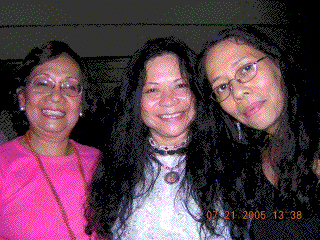
above: Evelie and Agnes (on the right); I think the woman in pink is Ms Atienza...from a women's NGO (click image for large version)
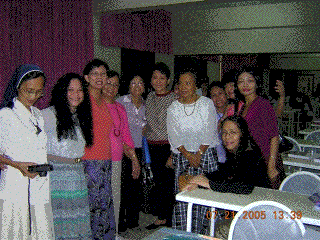
above: with Senator Leticia Shanani (in native dress); Grace Nono in purple, and Sister Datung (nun)(click image for large version)
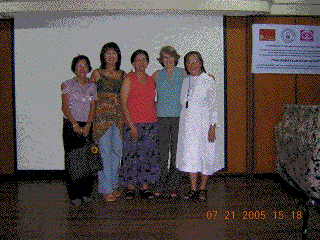
above: With Carolyn Brewer and Fe Mangahas and Sister Mary John (click image for large version)
From the Babaylan Symposium, St. Scholastica's College, Manila, July 22, 2005
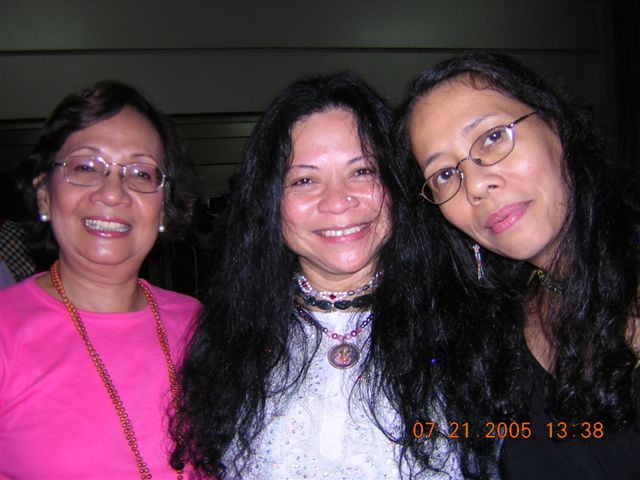
above: Evelie and Agnes (on the right); I think the woman in pink is Ms Atienza...from a women's NGO (click image for large version)
above: with Senator Leticia Shanani (in native dress); Grace Nono in purple, and Sister Datung (nun)(click image for large version)

above: With Carolyn Brewer and Fe Mangahas and Sister Mary John (click image for large version)
Sunday, February 01, 2004
Interfaith, International Conference on Sexuality - March 18-21, 2004
Thanks to Letecia Layson for this information:
The Pacific Asian and North American Asian Women in Theology and Ministry (PANAAWTM) is holding an INTERFAITH, INTERNATIONAL CONFERENCE ON SEXUALITY March 18-21, 2004 at Mills College, Oakland, CA, the first such conference from an Asian cultural perspective. Scholars and religious practitioners from Hinduism, Buddhism, Islam, Judaism, and Christianity will speak.
Open to women scholars, religious practitioners, graduate students, seminarians and undergraduate students of any ethnicity, race, sexual orientation, and nationality. There is money available for assistance with travel (up to $200 per person) and room and board at Mills. There is also assistance for room and board expenses for those in the Bay Area.
The conference opening panel:
"Religion, Sexuality, and Asian and Asian American Cultures: Embodying the Spirit in our Communities"
Panelists: Mehnaz Afridi, Carol Himaka, Kwok Pui Lan, Patricia Lin, Ruth Vanita.
Respondant: Mary Ann Tolbert
Free and open to the public and will take place at the Pacific School of Religion,
Bade Museum, 1798 Scenic Ave, Berkeley, Thursday, March 18 at 7 pm, Reception at 6:30.
The schedule with a list of speakers can be viewed at the website; click here. Special workshops on the conference theme, plus mentoring for those in religion Ph.D. programs.
Registration information can be found on-line. The on-line registration process can only be used with a credit card. Those needing financial assistance for travel and room should use hardcopies of the registration forms. Please urge those you think would be interested to attend.
Rita Nakashima Brock, Ph.D.
Visiting Scholar
Starr King School, Graduate Theological Union
260 Euclid Ave.
Oakland, CA 94610
The Pacific Asian and North American Asian Women in Theology and Ministry (PANAAWTM) is holding an INTERFAITH, INTERNATIONAL CONFERENCE ON SEXUALITY March 18-21, 2004 at Mills College, Oakland, CA, the first such conference from an Asian cultural perspective. Scholars and religious practitioners from Hinduism, Buddhism, Islam, Judaism, and Christianity will speak.
Open to women scholars, religious practitioners, graduate students, seminarians and undergraduate students of any ethnicity, race, sexual orientation, and nationality. There is money available for assistance with travel (up to $200 per person) and room and board at Mills. There is also assistance for room and board expenses for those in the Bay Area.
The conference opening panel:
"Religion, Sexuality, and Asian and Asian American Cultures: Embodying the Spirit in our Communities"
Panelists: Mehnaz Afridi, Carol Himaka, Kwok Pui Lan, Patricia Lin, Ruth Vanita.
Respondant: Mary Ann Tolbert
Free and open to the public and will take place at the Pacific School of Religion,
Bade Museum, 1798 Scenic Ave, Berkeley, Thursday, March 18 at 7 pm, Reception at 6:30.
The schedule with a list of speakers can be viewed at the website; click here. Special workshops on the conference theme, plus mentoring for those in religion Ph.D. programs.
Registration information can be found on-line. The on-line registration process can only be used with a credit card. Those needing financial assistance for travel and room should use hardcopies of the registration forms. Please urge those you think would be interested to attend.
Rita Nakashima Brock, Ph.D.
Visiting Scholar
Starr King School, Graduate Theological Union
260 Euclid Ave.
Oakland, CA 94610
Subscribe to:
Posts (Atom)