Over the weekend of May 15, Letecia Layson attended the RCG-I Gathering of Priestesses and Goddess Women in Wisconsin Dells, Wisconsin. There Leticia presented a workshop titled workshop "Babaylan - Past, Present and Future". The Center asked Letecia to share her experiences there. Part 1 of this article is her open letter to the Babaylan Yahoo group. Part 2 sets the context of her presentation. Part 3 is the resources she provided to workshop participants.
Greetings from Southern CA!
Thank you for attending my workshop at the RCGI Priestess and Goddesswomen gathering. Congratulations to the congregation for 25 years of service to women and the community. Congratulations to the four new ordained Priestesses! I feel fortunate to be a witness to so much joy, fun, laughter, deep sharing and a time capsule to be opened at the 50th - wow!!
I appreciate the patience you had for the technical difficulty, though you briefly were able to hear the voice of Mendung Sabal, who died a few months ago.
Mendung Sabal is one of the 10 Filipino Oralists interviewed in The Shared Voice - Chanted and spoken narratives from the Philippines by Grace Nono At the end of the post I am including (see part 3) resources where you might be able to find books I listed, or invite your local library to order them and have them on hand. Maybe you will be able to get them by way of interlibrary loans. Here are a a few of Grace's videos (eds note: the first few seconds of the Balaleng Video has a sharp teleprompter tone. Please be patient and wait through it, the video is well worth it.)
The time we had together seemed too short and I hope I did not overwhelm you with information. This workshop is inspired by the work co-presented at past gatherings with Deb Trent "She of Many Colors" It was my hope and intention to honor Deb with is work, our ancestors, our teachers, the ancestors of the land, the elements and the elementals.
It was is important to set a context from which the babaylan tradition lives in - yes, a living tradition that managed to exist through the 333 years of colonization by Spain and the 50 years of the USA's presence in the Philippines. "Without looking back at the past, one cannot go forward into the future." -- Jose Rizal. The challenge I had presenting the material is in the relam of the Sacred, the past is now, the future is now and the present in now. "The Geography of Thought" by Richard Nisbett shares insights into how culture affects thinking processes - the differences of Eastern and Western thought. Here is a review of the book.
"The Shared Voice" by Grace Nono also provides some good references regarding the oralist and the literate styles, recognizing the secondary oralist as one who bridges the two styles using both systems. Note: the book comes with a CD that has recordings of those interviewed with their music/songs with English translations in the book. To quote Grace:
"It is an enormous challenge for oral traditions to thrive in the era of globalization that has followed centuries of colonization. The survival of these traditions requires conscious effort, fortitude, and commitment, not for one, ten or a hundred, but of all Filipinos who are reawakened to the oralist calling."
"May we, secondary oralists, develop the habit of regular self-examination as well as a general attitude of humility in the face of our own frailties, and in acknowledgement of the inexhaustible source of wisdom from which we can draw guidance, hope, and inspiration in the course of our journey."
I shared two poems that nested the major content of the workshop, Recipe for Cooking Fear and We Are Born With Gifts, written by Leny Mendoza Strobel from A Book of Her Own - Words, Images to Honor the Babaylan. You can find links at Leny's website for her blog. Leny's first book, Coming Full Circle - THE PROCESS OF DECOLONIZATION AMONG POST-1965 FILIPINO AMERICANS identifies the experience of many Filipino Americans. While my experience being born to a Manong who arrived on the mainland in 1926 at age 16 and a WWII War Bride, who arrived on the mainland on 1947 (just as the Philippines was given its independence at the end of WWII) had many similarities as described in Coming Full Circle, I was raised with traditional Filipino values in the home.
Two streams of western Goddess Traditions and Filipino Spirituality/ religion came together in the first series of classes I took at Circle of Aradia in Feminist Witchcraft in the Dianic Tradition. At the end of the first class we were asked to research a Goddess from our ethnic background and if that was not something that worked for us, research a Goddess that called to us. The Coulorful Mandaya: Ethnic Tribe of Davao Oriental by Ursula Cinc Valderrama. The book is an ethnographic study of the people (you can read a bit about them here). In the chapter "The making of Baylan (the same as a babaylan)" the rituals, chants, etc are included. Any woman of the tribe can be a baylan (providing they qualify), a priestess. The diwatas show their acceptance by possessing the baylan becoming a channel, oracle, healer, visionary, etc. During the ordination ceremony, the woman would need to invoke and make tributes to Gamaogamao, believed to be a water goddess.
I spent the next five weeks meditating on/with Gamaogamao as part of the workshop series. I was to ask if there was something that She wanted share with the women of the class and what She wanted me to tell the women about her. The last class we were required to invoke and aspect (speak as) our Goddess. I invoked and spoke as Gamaogamao in that last class forever linking my two spiritual streams.
Republished with permission and gratitude. Links accessed 6/15/09.
Monday, June 15, 2009


Wednesday, June 10, 2009
Performances: diwang ilaw: inner dance spoken word
diwang ilaw: inner dance spoken word @ grace exhibition space in brooklyn 2/6/09
Philippe Javier Garcesto is a NYC-based Filipino-American Multi-Disciplinary Artist who transforms and energizes each venue according to the essence of the performance piece. Leaving his homeland of Iloilo, the City of Love, at the tender age of 8 for the exotic suburbs of Maplewood, New Jersey his work is about balance between worlds. He walks a fine balance between two aspects of the brain hemispheres of intellect and intuition, science and spirituality, west and east. He often metamorphs into his alias Diwang Ilaw, which is translated as “Spirit of Light” in the Earth-rooted language of Tagalog, who is a holistic healer fusing the Babaylan techniques of Inner Dance with surgical lyrical barrages of Spoken Word Poetry. He summons the spirits of all humans living or dead, all creatures and plants, the Earth, and the Universe to flow through him to reawaken humanity to the collective power found within themselves as individual co-creators of our reality. He considers his art movement as Multi-Media Holistic Arts Activism designed to raise consciousness and awareness of the interconnectedness of all things and the Love that binds us all as One.
Submitted by Leny Strobel
Links accessed June 3, 2009
diwang ilaw: inner dance spoken word @ grace exhibition space in brooklyn 2/6/09 from Philippe Garcesto on Vimeo.
Philippe Javier Garcesto is a NYC-based Filipino-American Multi-Disciplinary Artist who transforms and energizes each venue according to the essence of the performance piece. Leaving his homeland of Iloilo, the City of Love, at the tender age of 8 for the exotic suburbs of Maplewood, New Jersey his work is about balance between worlds. He walks a fine balance between two aspects of the brain hemispheres of intellect and intuition, science and spirituality, west and east. He often metamorphs into his alias Diwang Ilaw, which is translated as “Spirit of Light” in the Earth-rooted language of Tagalog, who is a holistic healer fusing the Babaylan techniques of Inner Dance with surgical lyrical barrages of Spoken Word Poetry. He summons the spirits of all humans living or dead, all creatures and plants, the Earth, and the Universe to flow through him to reawaken humanity to the collective power found within themselves as individual co-creators of our reality. He considers his art movement as Multi-Media Holistic Arts Activism designed to raise consciousness and awareness of the interconnectedness of all things and the Love that binds us all as One.
Submitted by Leny Strobel
Links accessed June 3, 2009
Monday, June 08, 2009
In The News: Bay Area Artists Revive Old Filipino Writing
Bay Area Artists Revive Old Filipino Writing
Sharon Chin reporting for CBS5, San Francisco
Some Bay Area residents are trying to revive an ancient writing system from The Philippines they say hasn't been used in centuries. It's a forgotten script that many in the Filipino community are only just discovering.
The language is called Baybayin, and Filipino-American artists are trying to keep it alive, to connect with their heritage. Babybayin migrated from the island of Java from a script called Kavi. But the script was replaced by the Western alphabet soon after the Spanish colonized The Philippines.
Our video report has more. Features artists Christian Cabuay and Christine Balza.
Submitted by Leny Strobel
Link accessed 6/8/09. Note that the feed was slow.
Sharon Chin reporting for CBS5, San Francisco
Some Bay Area residents are trying to revive an ancient writing system from The Philippines they say hasn't been used in centuries. It's a forgotten script that many in the Filipino community are only just discovering.
The language is called Baybayin, and Filipino-American artists are trying to keep it alive, to connect with their heritage. Babybayin migrated from the island of Java from a script called Kavi. But the script was replaced by the Western alphabet soon after the Spanish colonized The Philippines.
Our video report has more. Features artists Christian Cabuay and Christine Balza.
Submitted by Leny Strobel
Link accessed 6/8/09. Note that the feed was slow.
Friday, June 05, 2009
Kapwa Conference 09
Kapwa Conference 09
San Francisco State University
*** SATURDAY, JUNE 27, 2009 ***
WHAT IS KAPWA? Kapwa is a Filipin@ word that describes oneness, interconnectedness, holism, and symbiosis among living beings and the broader environment.
Kapwa Conference 09, organized by Pin@y Educational Partnerships and Fulbright-Hays Philippines Study Tour 2008, will focus on the work of educators to better serve the diverse nature of today’s student population – Filipin@ youth, people of color, and similarly marginalized persons to transcend the effects of colonization and go beyond the basics of identity politics, to develop survival strategies, foster healing, and to build bridges and nurture community.
Through lectures, panels, roundtables, symposia, workshops, exhibits and performances, we will specifically explore roles and perspectives at the intersections of the Global, Local, and Personal levels. Please visit the Presenters’ pages for Global, Local, and Personal to see the full range of topics, including critical pedagogy, arts integration, history, activism, gender and sexuality, and equity in education.
San Francisco State University
*** SATURDAY, JUNE 27, 2009 ***
WHAT IS KAPWA? Kapwa is a Filipin@ word that describes oneness, interconnectedness, holism, and symbiosis among living beings and the broader environment.
Kapwa Conference 09, organized by Pin@y Educational Partnerships and Fulbright-Hays Philippines Study Tour 2008, will focus on the work of educators to better serve the diverse nature of today’s student population – Filipin@ youth, people of color, and similarly marginalized persons to transcend the effects of colonization and go beyond the basics of identity politics, to develop survival strategies, foster healing, and to build bridges and nurture community.
Through lectures, panels, roundtables, symposia, workshops, exhibits and performances, we will specifically explore roles and perspectives at the intersections of the Global, Local, and Personal levels. Please visit the Presenters’ pages for Global, Local, and Personal to see the full range of topics, including critical pedagogy, arts integration, history, activism, gender and sexuality, and equity in education.
Thursday, June 04, 2009
Features: Back from the Goddess Gathering - Part 1
Over the weekend of May 15, Letecia Layson attended the RCG-I Gathering of Priestesses and Goddess Women in Wisconsin Dells, Wisconsin. There Letecia presented a workshop titled workshop "Babaylan - Past, Present and Future". The Center asked Letecia to share her experiences there. Part 1 of this article is her open letter to the Babaylan Yahoo group. Part 2 sets the context of her presentation. Part 3 is the resources she provided to workshop participants.
Dear all,
I think the workshop "Babaylan - Past, Present and Future" went well. The women seemed to get a lot out of it, some taking notes, tears, laughter, big ah-ha's The workshop was about 1.5 hrs Out of the 15 women in the workshop, five women (including me) who do not identify with European Roots/History - a woman from Mexican heritage, Korean - mixed blood, Native American - mixed blood and a woman from Puerto Rico. All women at the gathering are in agreement with The Affirmation of Women's Spirituality, are woman honoring, woman identified and generally focused on Goddess Centered, but not all from the same religions our spiritual traditions (meaning there were women who identified as witches, pagans, native american traditions, Mayan, buddhist, hindu, etc).
Before the gathering there was a Goddess Symposium which I was able to attend. The participants are part of the RCGI community. Kathryn Henderson presented a talk on "Working with Living Traditions with Respect". She interviewed Buddhist, Hindu, Voodoo, Yoruba and Native American spiritual leaders. She had a lovely one page handout with guidelines developed from the interviews, which was simple and direct. I referenced her work at the beginning of my workshop to remind women that there are unbroken lineages of babaylans in the Philippines. As a FilAM woman, I too must approach these lineages/teachings/ people with the proper respect, though my roots are also from similar cultures.
[In Part 2 of this post] the reference materials sent to the women of the workshop [appear] - and of course [I] invited them to come to the Babaylan Conference in 2010!
I had a simple 1 pg outline that I worked from, starting out with a welcome and a check-in. Women were asked to say three things, their name, the ethic or culture they identified with and their religion/spirituali ty. Once the check-ins were complete I spoke to the elements and the elementals, the ancestors the women just spoke of, the ancestors of the local land and invited them to be with us, to support us in the work we were about to begin.
I had a simple altar that included two pictures, one of my two sisters, mom and me, the other one was taken at the FAWN2005 gathering with some of you in it. I introduced you to the group and let them know this virtual circle has supported me on so many levels stepping forward in knowing more about the Babaylan. And then I read a poem from Leny's A Book Of Her Own, "Recipe for Cooking Fear." At the end I held up the garlic that was near me on the altar.
I quoted Jose Rizal "Without looking back at the past, one can not go forward into the future." In order for the women to appreciate who the babaylans are/were, I needed to set a context in her/history, language, the georgraphy of thought, tacit knowledge, oral and literate ways of transmitting, sharing and recording information by way of poems, images, crafts, dance, music, song, etc. I talked about the challenges that Filipina/o authors have writing in English about our culture and wondering where the audience is for the writing - yet still writers write and books are created.
I talked about decolonization and felt hearts breaking - open. Paraphrasing Grace Nono by telling them "there is not a single one of us in this circle who has not be touched by colonization, either by being colonized or as a colonizer," it is time to work together now to move forward for all the children. The women of color were relieved I spoke of these issues, especially the woman from Puerto Rico who shared briefly what it was like politically - how Puerto Rico not too long ago was able to have a sense of self government, but are still a colonial holding. She cried and I think felt relieved that she could share the difference and the frustration. She also shared how she was pained knowing her ancestors had almost killed an entire race, some of her other ancestors - having difficulty finding a place to speak about the internalized pain and confusion. She is the one who asked about Hooponopono (see links at the end of the post). A Hawaiian practice of forgiveness and healing. But I digress...
I told my story, of how I first came to know about babaylans - 18 years ago in my first classes on Dianic Witchcraft and read from The Coulorful Mandaya: Ethnic Tribe of Davao Oriental by Ursula Cinc Valderrama
While the outline I was working from had a progression, the items were presented based on the energetic in the room. How the women responded to what was being said and what else needed to be clarified, processed or referenced before moving on. So even now I am not clear on which went topic followed/flowed one after the other. I am pretty sure the unfolding into Babaylan was easy from here out....the past and the present linking in the readings from Perla's Babaylan.com website article on Leadership, to Marianita (Girlie) Villariba's article "Babaylan Women as Guide to a Life of Justice and Peace", touching on creation stories, Filipino Psychology and Kapwa. I read from Agnes' Babaylan:She Dances to Wholeness' noting the intersecting realities of political and sacred, the dance of life and creation.
Examples of present rising of the Babaylan Spirit as in Babaylan UP, Denmark and Europe. Of Ann's work, Evelie's work, Geejay's work and the work of your circle.
I encouraged the women to reconnect with their own roots and make a commitment to step forward as herstory makers, women of spirit and women who work to ensure that all children are cared for in a good way. We did not have time do dance...though I closed with a second poem from Leny "We Are Born With Gifts."
They clapped, hugged me, thanked me and I was especially touched by the connection with the women of color. Lol, they were warned at the beginning of the workshop, they might not remember much of what was said....but they would leave here feeling better....and they did. Each woman seemed to have a sense of relatedness to each other and to the notion of Babaylan.
Hope this makes a bit of sense to you....
Thanks to Bec and Leny for encouraging me to share with the list. And thank everyone here. Your contributions to the list found their way in part of the weave of the magic I shared at the RCGI gathering. I excited about the upcoming conference. It is really amazing to see how the notion and spirit of the babaylan and babaylanism is touching people in a good way.
Love, Letecia
Republished with permission and gratitude. Links accessed 6/5/09.
Dear all,
I think the workshop "Babaylan - Past, Present and Future" went well. The women seemed to get a lot out of it, some taking notes, tears, laughter, big ah-ha's The workshop was about 1.5 hrs Out of the 15 women in the workshop, five women (including me) who do not identify with European Roots/History - a woman from Mexican heritage, Korean - mixed blood, Native American - mixed blood and a woman from Puerto Rico. All women at the gathering are in agreement with The Affirmation of Women's Spirituality, are woman honoring, woman identified and generally focused on Goddess Centered, but not all from the same religions our spiritual traditions (meaning there were women who identified as witches, pagans, native american traditions, Mayan, buddhist, hindu, etc).
Before the gathering there was a Goddess Symposium which I was able to attend. The participants are part of the RCGI community. Kathryn Henderson presented a talk on "Working with Living Traditions with Respect". She interviewed Buddhist, Hindu, Voodoo, Yoruba and Native American spiritual leaders. She had a lovely one page handout with guidelines developed from the interviews, which was simple and direct. I referenced her work at the beginning of my workshop to remind women that there are unbroken lineages of babaylans in the Philippines. As a FilAM woman, I too must approach these lineages/teachings/ people with the proper respect, though my roots are also from similar cultures.
[In Part 2 of this post] the reference materials sent to the women of the workshop [appear] - and of course [I] invited them to come to the Babaylan Conference in 2010!
I had a simple 1 pg outline that I worked from, starting out with a welcome and a check-in. Women were asked to say three things, their name, the ethic or culture they identified with and their religion/spirituali ty. Once the check-ins were complete I spoke to the elements and the elementals, the ancestors the women just spoke of, the ancestors of the local land and invited them to be with us, to support us in the work we were about to begin.
I had a simple altar that included two pictures, one of my two sisters, mom and me, the other one was taken at the FAWN2005 gathering with some of you in it. I introduced you to the group and let them know this virtual circle has supported me on so many levels stepping forward in knowing more about the Babaylan. And then I read a poem from Leny's A Book Of Her Own, "Recipe for Cooking Fear." At the end I held up the garlic that was near me on the altar.
I quoted Jose Rizal "Without looking back at the past, one can not go forward into the future." In order for the women to appreciate who the babaylans are/were, I needed to set a context in her/history, language, the georgraphy of thought, tacit knowledge, oral and literate ways of transmitting, sharing and recording information by way of poems, images, crafts, dance, music, song, etc. I talked about the challenges that Filipina/o authors have writing in English about our culture and wondering where the audience is for the writing - yet still writers write and books are created.
I talked about decolonization and felt hearts breaking - open. Paraphrasing Grace Nono by telling them "there is not a single one of us in this circle who has not be touched by colonization, either by being colonized or as a colonizer," it is time to work together now to move forward for all the children. The women of color were relieved I spoke of these issues, especially the woman from Puerto Rico who shared briefly what it was like politically - how Puerto Rico not too long ago was able to have a sense of self government, but are still a colonial holding. She cried and I think felt relieved that she could share the difference and the frustration. She also shared how she was pained knowing her ancestors had almost killed an entire race, some of her other ancestors - having difficulty finding a place to speak about the internalized pain and confusion. She is the one who asked about Hooponopono (see links at the end of the post). A Hawaiian practice of forgiveness and healing. But I digress...
I told my story, of how I first came to know about babaylans - 18 years ago in my first classes on Dianic Witchcraft and read from The Coulorful Mandaya: Ethnic Tribe of Davao Oriental by Ursula Cinc Valderrama
While the outline I was working from had a progression, the items were presented based on the energetic in the room. How the women responded to what was being said and what else needed to be clarified, processed or referenced before moving on. So even now I am not clear on which went topic followed/flowed one after the other. I am pretty sure the unfolding into Babaylan was easy from here out....the past and the present linking in the readings from Perla's Babaylan.com website article on Leadership, to Marianita (Girlie) Villariba's article "Babaylan Women as Guide to a Life of Justice and Peace", touching on creation stories, Filipino Psychology and Kapwa. I read from Agnes' Babaylan:She Dances to Wholeness' noting the intersecting realities of political and sacred, the dance of life and creation.
Examples of present rising of the Babaylan Spirit as in Babaylan UP, Denmark and Europe. Of Ann's work, Evelie's work, Geejay's work and the work of your circle.
I encouraged the women to reconnect with their own roots and make a commitment to step forward as herstory makers, women of spirit and women who work to ensure that all children are cared for in a good way. We did not have time do dance...though I closed with a second poem from Leny "We Are Born With Gifts."
They clapped, hugged me, thanked me and I was especially touched by the connection with the women of color. Lol, they were warned at the beginning of the workshop, they might not remember much of what was said....but they would leave here feeling better....and they did. Each woman seemed to have a sense of relatedness to each other and to the notion of Babaylan.
Hope this makes a bit of sense to you....
Thanks to Bec and Leny for encouraging me to share with the list. And thank everyone here. Your contributions to the list found their way in part of the weave of the magic I shared at the RCGI gathering. I excited about the upcoming conference. It is really amazing to see how the notion and spirit of the babaylan and babaylanism is touching people in a good way.
Love, Letecia
Republished with permission and gratitude. Links accessed 6/5/09.
Wednesday, June 03, 2009
Performances: MEBUYAN/The Mebuyan Peace Project
Mebuyan, a women-led music group based in Davao City, Philippines, is composed of Geejay Arriola (artistic director, percussionist), Gauss Obenza (music director, guitarist), Maree Contai (percussionist), Maan Chua (guitarist), Paolo Sisi (bassist), Chico Zambrano (drummer, percussionist), and Lolong Gonzaga (keyboardist), is a child of the Mebuyan Peace Project.
The group has released its first album entitled Mga Kuwentong Bata
The album features compositions by Geejay Arriola, Bayang Barrios, Gauss Obenza, Maree Contaoi, Maan Chua, Maia Tampoy, and Sheila Labos.
Mebuyan Peace Project is a group of 18 women arts and development workers based in Mindanao, Philippines. These women have worked individually or as members of other organizations in various peacemaking and theatremaking projects for at least 10 years.
On May 18 2001, the women of these music and theater groups gathered and gave birth to Mebuyan Peace Project—a theatre and musical storytelling group. The idea is to produce artistic performances that will respond to women's and children's concerns in relation to the issues of personal, domestic, community, regional, and global peace.
We also aim to help develop artists and peacebuilders through trainings and workshops in:
—creative writing
—child rights
—children's theatre
—improvisational theatre
—cultural action
—dance and movement
—environmental awareness
—gender in development
—global education
—music and voice
—music writing
—organizational development
—peacemaking
—storytelling
—theatre (acting, directing, playwriting, production design, lights design)
—theatre in education
—visual arts
We also hope to encourage and popularize women's arts and theatre through storytelling, music, and theater performances, and to popularize women's and children's issues through workshops and performances.
Our mat is a world
where arts is the norm rather than a specialty.
where there are no sounds of war and greed, only sounds of music and laughter.
where men and women are given equal opportunities.
where every woman and child knows no hate nor fear.
where every home is the safest and most peaceful place on earth.
where arguments end in songs, not in fistfights.
where cultural diversity is celebrated, not wiped out.
Submitted by: Geejay Arriola
All links accessed date of this post.
Tuesday, June 02, 2009
Conversations: Land and Women - The Matrilineal Factor
Land and Women: The Matrilineal Factor
The cases of the Republic of the Marshall Islands, Solomon Islands and Vanuatu
by Kristina E. Stege, Ruth Maetala, Anna Naupa & Joel Simo. Pacific Islands Forum Secretariat, Elise Huffer, Editor (2008)
Introduction
“The women here are so sure of themselves… maybe it’s that we know for sure that we have land…Even if I don’t get land from my husband, I still have it from my mother and nothing can change that…”— (Palauan woman [no name given], cited in Margold and Bellorado, 197?)
This report brings together three studies on matrilineal land tenure carried out in the Republic of Marshall Islands (RMI), Vanuatu and Solomon Islands. The respective authors, Kristina Stege, Anna Naupa and Joel Simo, and Ruth Maetala, conducted their research in at least two areas in each country – including one urban and one rural – with the overall objective of providing a better understanding of the current status of women in relation to land tenure, land management and
access to land in matrilineal areas.
This work is aimed at contributing a gendered perspective to the current regional focus on land issues and reform, particularly initiatives such as the Pacific Islands Forum Secretariat’s Land Management and Conflict Minimization for Peace, Prosperity and Sustainable Development project (LMCM) and AusAID’s Pacific Land Program. It is also designed to provide updated, accessible
and locally derived information and recommendations for national land policy and legislative changes currently taking place in the three focal countries.
Submitted by Letecia Layson
Full text accessed 5/31/2009
The cases of the Republic of the Marshall Islands, Solomon Islands and Vanuatu
by Kristina E. Stege, Ruth Maetala, Anna Naupa & Joel Simo. Pacific Islands Forum Secretariat, Elise Huffer, Editor (2008)
Introduction
“The women here are so sure of themselves… maybe it’s that we know for sure that we have land…Even if I don’t get land from my husband, I still have it from my mother and nothing can change that…”— (Palauan woman [no name given], cited in Margold and Bellorado, 197?)
This report brings together three studies on matrilineal land tenure carried out in the Republic of Marshall Islands (RMI), Vanuatu and Solomon Islands. The respective authors, Kristina Stege, Anna Naupa and Joel Simo, and Ruth Maetala, conducted their research in at least two areas in each country – including one urban and one rural – with the overall objective of providing a better understanding of the current status of women in relation to land tenure, land management and
access to land in matrilineal areas.
This work is aimed at contributing a gendered perspective to the current regional focus on land issues and reform, particularly initiatives such as the Pacific Islands Forum Secretariat’s Land Management and Conflict Minimization for Peace, Prosperity and Sustainable Development project (LMCM) and AusAID’s Pacific Land Program. It is also designed to provide updated, accessible
and locally derived information and recommendations for national land policy and legislative changes currently taking place in the three focal countries.
Submitted by Letecia Layson
Full text accessed 5/31/2009
Sunday, May 31, 2009
Conversations: Reclaiming the Southeast Asian Goddess
Reclaiming the Southeast Asian Goddess: Examples from Contemporary Art by Women
By Flaudette May V. Datuin
Image & Gender, vol. 6, 2006, pp.105-119
ABSTRACT
In this essay, I will invoke – as a form of strategic essentialism - the figure of the Southeast Asian goddess and the babaylan, the ancient priestess as theme, metaphor and signifier for women’s life-giving, nurturing and healing powers. By reclaiming the legacy of the Southeast Asian goddess, I will present the emerging outlines of a Southeast Asian feminist framework revolving around embodied spirituality – a concept where the body is construed as an anatomical, spiritual, social and psychic space grounded on fluidity and wholeness, instead of hierarchy and dualities. In the process, I will argue that while most women artists in Southeast Asia are not consciously and overtly “feminist,” they nonetheless point to the contours of emerging feminisms in Southeast Asia, and perhaps, in Asia. These “feminisms” cannot be defined solely on the basis of individual autonomy, hinged on sexual and body-centered liberation (as in radical feminism); or on “equal rights” in an untransformed social structure (as in liberal feminism).Drawing from my ongoing study and engagement with women artists in the visual arts of Southeast Asia, I will present examples of how selected Philippine, Indonesian and Thai women artists articulate and embody the Southeast Asian goddess figure through their lives and their works.
Submitted by: Mary Ann Ubaldo and Lorial Crowder
Full text accessed 5/31/2009
By Flaudette May V. Datuin
Image & Gender, vol. 6, 2006, pp.105-119
ABSTRACT
In this essay, I will invoke – as a form of strategic essentialism - the figure of the Southeast Asian goddess and the babaylan, the ancient priestess as theme, metaphor and signifier for women’s life-giving, nurturing and healing powers. By reclaiming the legacy of the Southeast Asian goddess, I will present the emerging outlines of a Southeast Asian feminist framework revolving around embodied spirituality – a concept where the body is construed as an anatomical, spiritual, social and psychic space grounded on fluidity and wholeness, instead of hierarchy and dualities. In the process, I will argue that while most women artists in Southeast Asia are not consciously and overtly “feminist,” they nonetheless point to the contours of emerging feminisms in Southeast Asia, and perhaps, in Asia. These “feminisms” cannot be defined solely on the basis of individual autonomy, hinged on sexual and body-centered liberation (as in radical feminism); or on “equal rights” in an untransformed social structure (as in liberal feminism).Drawing from my ongoing study and engagement with women artists in the visual arts of Southeast Asia, I will present examples of how selected Philippine, Indonesian and Thai women artists articulate and embody the Southeast Asian goddess figure through their lives and their works.
Submitted by: Mary Ann Ubaldo and Lorial Crowder
Full text accessed 5/31/2009
Thursday, May 28, 2009
Bahala Meditations: Renewal of Filipino Spiritual Practice
Perla Ramos Paredes Daly writes:
In the Jewish Tradition it is Yahweh. In English it is God. In Spanish it is Dios. In Islam it is Allah. In Christian tradition it is Father, Son and Holy Spirit, the mystery of the Holy Trinity. In pagan traditions it is Goddess or Great Mother. For the American Natives it is wording that translates to Great Spirit. Left-brainer, atheists may not believe in any god but they may believe in a Cosmic Intelligence that underlies the laws of physics and atomic existence in space and time.
And for the Filipino the Great Divine is called Bathala or Bahala. Even before the coming of the West the natives of the Philippine islands have had a spirituality and awareness of the Nameless-Many-Named-I-Am. By coming to rediscover the use of Bahala, so many more Filipinos today, cut-off and unaware of their spiritual roots, can come to discover and know that ancient traditions of the Philippine Islands have always carried Universal Wisdom...
Perla provides the meditations and contemplations online, noting:
There are three sets of exercises here.
1) Contemplation over the baybayin symbols that form the word Bahala.
2) Finding renewed meaning in saying Bahala Na
3) Saying Bahala or Bahala Na as a prayer/meditation entry point or as a spiritual chant.
Sites accessed 5/28/09
In the Jewish Tradition it is Yahweh. In English it is God. In Spanish it is Dios. In Islam it is Allah. In Christian tradition it is Father, Son and Holy Spirit, the mystery of the Holy Trinity. In pagan traditions it is Goddess or Great Mother. For the American Natives it is wording that translates to Great Spirit. Left-brainer, atheists may not believe in any god but they may believe in a Cosmic Intelligence that underlies the laws of physics and atomic existence in space and time.
And for the Filipino the Great Divine is called Bathala or Bahala. Even before the coming of the West the natives of the Philippine islands have had a spirituality and awareness of the Nameless-Many-Named-I-Am. By coming to rediscover the use of Bahala, so many more Filipinos today, cut-off and unaware of their spiritual roots, can come to discover and know that ancient traditions of the Philippine Islands have always carried Universal Wisdom...
Perla provides the meditations and contemplations online, noting:
There are three sets of exercises here.
1) Contemplation over the baybayin symbols that form the word Bahala.
2) Finding renewed meaning in saying Bahala Na
3) Saying Bahala or Bahala Na as a prayer/meditation entry point or as a spiritual chant.
Sites accessed 5/28/09
Wednesday, May 27, 2009
The Bathala Project
Finally after years in raising consciousness about our Filipino Spirituality, Bathala enters into the Fil-Am hip hop generation through the inspired Bathala Meditations. The magikal connection of Baybayin, our Ancient Philippine Script, and Bathala is finally understood!
bathala nawa!
For more information, go to The Bathala Project
Submitted by: Mary Ann Ubaldo
bathala nawa!
For more information, go to The Bathala Project
Submitted by: Mary Ann Ubaldo
Tuesday, May 26, 2009
Book and CD Review: The Shared Voice by Grace Nono

The Shared Voice: Chanted and Spoken Narratives from the Philippines by Grace Nono
Anvil Publishing. ISSN:97127-20437 (2008)
Leny asked: Letecia - Can you please write a review of the book from your perspective as a second generation, daughter of Manong?
Letecia responded: I am so use to just having my own epiphany in the wee early morning hours. Often words don't form in my brain, much less sentences. I just sense something is different inside of me...an energy release, a veil lifted, a 'knowing' revealed. The odd thing is that the 'knowing' is not just mine, Letecia's, it seems to an echo of what simply is, has been, always was and never was not. The 'knowing' is not something that was 'spoken' to me in a literal sense, perhaps only hinted at, or l observed it (whatever it is) and it lived in my presence. You know when you are looking at a picture and suddenly you see the white space between the pixels of colored dots...I feel myself sort of 'shake it off' and zoom out again to see the picture ever more clearly. Sometimes words are spoken in my head, phrases or a story takes shape as images flash by.
I felt something had shifted in me after reading 'The Shared Voice,’ it happened in my sleep....Like Magic! Really I am not sure what happened, or why, but I have a sense of 'rightness' in the world. LOL and perhaps if we were in a room sharing stories and thoughts about the book, more words would flow freely in the dialogue which allows for the connectedness, reflection, warm smiles and laughter. Writing is essentially a monologue and I am not so sure what I have to say is interesting or important, or will even make sense to someone else. And if I fix my thoughts into print (either on paper or on a screen) it feels a bit rigid....the words reflect a moment in time....not what is happening as my fingers are tying the letters to this sentence.... they are reflections of the past.....always trying to catch up to the present moment.
And even with all that being said....I wonder if 'tacit knowledge' is asserting itself rising from ancestral waters and has me qualifying my words as 'not very important' to deflect anyone from noticing 'the words of power that I speak' I learned of a concept called Buyag when I was in PAWWA (Philippine American Women Writers and Artists accessed 5/26/09)
"Buyag" or "Pwera/Purya Buyag" is an expression that is meant to ward off "Evil Eye" when you praise or take notice aloud of someone, especially a baby. Old folks believe so and there is no harm if the younger generation say it too... " Yahoo Answers (accessed 5/26/09)
I realized then and even today, how Buyag or Pwera/Purya Buyag whispers in my blood. I don't even really know how to pronounce the words, so I look forward to someone calling me up and speaking it into a voice mail for me (smile), or send me a video message on Seesmic.
See what I mean...the deflect away from my own shared thoughts...for now, I have quieted the voice some by getting a piece of garlic and setting it on my altar (if I had a pocket in what I am wearing, the garlic would be in it!)...
For those of you who want the short version 'TWO THUMBS UP', 5 out of 5 stars. 'The Shared Voice: chanted and spoken narratives from the Philippines' by Grace Nono is a Divine Find.
I am listening to the CD as I type to you. Nono's book provides a bridge from the past to the future of a Filipino Spirituality that lives - a living tradition. One that is represented not only by the primary oralist, but also by the secondary oralists and each of us who identify as Filipino and Spiritual - beyond organized religion and inclusive.
Grace is a good storyteller. As I read, I felt the conversational tone of her writing open my mind and heart - stretching me open to my own paradoxical nature of living in two worlds - the natural world and a constructed world. I read to myself out loud, letting the sounds of the words work like incantations, not holding tightly to my own pre-conceived ideas about what Filipina/os are like, or who I am being....just allowing and listening. I would read some and then listen to the CD.
Even the academic models, the history and statistics flowed like nectar. If you asked me now what was said I would have to pull out the book to quote it....and I am not sure if there was anything specific that touched me other than the wholeness of the presentation. Hmm, I guess if I looked at it like a faceted jewel, one of the facets that etched in my brain is Table 1. Oralist and Literate: A Comparison on page 22. I am making a copy of it and posting it on my wall as a reminder of my own dynamic flow between these two systems and ways of being.
I am not one or the other, I am an AND/AND, a both, not an either or. Even now I laugh at myself knowing that in future days I will use this table to support my desire to 'not write' to continue to 'be-speak the world into being.'
I felt properly introduced to these 10 elders, to know their place, their families, their people and I realize how limited the introductions are here in the USA - your name, what you do, where you live. Here in the USA, it is your intimates that you share the information about your ancestral place, your people, etc. What rich and vital traditions each of these 10 elders come from. For the secondary oralists, those that bridge the ancient/future lineages, they are my She-ros and He-ros. They find ways to live a continuum... NOW, NOW, NOW the past is now, the future is now, the present is now, if this is making any sense.
Almost 20 years ago when I started my training in the Dianic Tradition, we were asked to research a goddess from our ethnic background. During the next 5 weeks, I was to spend time with Her, using whatever written information I could find and if there was not much - to meditate with Her, Her symbols or any means to listen to what She might have to share with me personally and if there was something She wanted to share with the women of the class. In the last class I invoked Her, using the skill set we learned in class and to aspect Her (let Her speak through me) so that the women in the circle might be able to meet Her. It was through this process, the invocation of Gamaogamao* and time spent with her that stepping forward on my spiritual path of service as a Dianic is forever entwined with my ancestral spirituality.
Grace's book provided a deeper context from which I could understand my own spiritual calling - from the ancestors and the elements. As a daughter of a Manong and a Filipina war bride, I was not raised speaking either language of my parents or Tagalog - only English. I think the ancestors had to speak to me elementally - through nature and through many other earth-based traditions that are rooted in the lands they originated from. It is only now, and in the last 20 years, that FilAm's like me have had access to information about our culture and traditions in English. I used to think my experience was unique, and as my mother use to remind me, to keep quiet about it (she was after all a good Catholic). I feel fortunate to be living in a time where information is shared and I can see that I am not unique, but one of the many displaced Filipinas who have managed to stay steady and listen.
I have honed my lens/worldview as a feminist - radical at that. The good news is the mentors and teachers encouraged me to do my own research, be in the center of my own life and comfortable in my own skin as a woman. The Shared Voice has added to the context of who I am in the world - how I am in service to my communities and has me questioning, if I was raised in the Philippines and had access to elders of these living traditions would I have made my way to their mountain tops or to their remote villages in the same way I have found elders here in the USA?
I’d like to think so, but I will never know what could have been. I only know what is and what might be...I feel fortunate to have found this virtual circle - each of you who are on this list has contributed to the bridging and integration of my spirit calling and how it out-pictured itself in me as a Priestess in European-based Goddess Traditions. On this list our conversations, book suggestions, gatherings, etc., have helped me to own the gifts that are from my/our ancestral pool of wisdom. All the formal training, reading, references in the Goddess traditions I am ordained in are from other lands, not even from the land from which I was born (USA). They are from the lands of the colonizers, reaching back into their roots, to their ancestors, to the roots of their religions, consciousness, medicine, philosophy, science, literature, art - all the way back to the neolithic.
The Shared Voice reminds me....we are all connected to lands, ancestors and nature. Living Traditions need to include the her/history and all the diversity and richness we represent. The Shared Voice helps me to feel even more at home in my own dance - in my own body by giving voice to what I did not know needed to be spoken.
In closing, I add my voice in gratitude and blessings of a work well done. I am changed by the work in subtle ways....which will bubble up through my own words, works, songs, dance and stories....
Thanks Leny for asking. Thanks Baylan for getting a copy of the book to me....and Thanks Grace for writing and sharing your words, images and song.
PS. Do I need to be worried about Buyag or Pwera/Purya Buyag ? (smile)
*From "The Colourful Mandaya: Ethnic Tribe of Davao Oriental" by Ursla Cinco Valderrama, pg 30. The making of a Balyan: "Gamaogamao is believed to be the goddess of water..."
Review submitted by: Letecia Layson.
Editor’s note: This post appeared originally on the Yahoo listserve group “Babaylan” on May 9, 2009 and has been edited slightly to correct spelling/capitalization errors and smooth paragraph transitions. Every effort was made, however, to maintain the conversational quality of the post. The editor apologizes for any subtle changes in meaning as a result.
Monday, May 25, 2009
Mysteries of faith abound in Mt. Banahaw
DOLORES, Quezon – For some people, leaving their comfortable life to take the road to Mount Banahaw is God’s “calling.” A renewal in the mystic mountain, they say, is a product of their greatest challenges.
Banahaw remains a haven for people in search of spirituality. “Whether it’s Catholic, Born Again or whatever group, these are just branches of only one tree that leads to Him,” said Bernard Forbile, 50.
Forbile is a missionary of the Kapatiran ng Sampung Utos, a “brotherhood” of Ten Commandments devotees founded in the 1980s. The other groups are the Tatlong Persona sa Kinabuhayan, Rosa Mystica and the Rizalistas.
“You will not be saved by your group, but by your faith,” Forbile says.
Shrines
During the Lenten season, over a thousand devotees from Manila, Laguna, Batangas and Quezon flock to Banahaw as early as Biyernes de Dolores (Friday before Palm Sunday).
Many caves or stations have become shrines or dalanginan based on the local belief that these natural rock formations are sacred because of “unexplainable” markings.
For instance, a shrine called Jerusalem has a child’s footprint, believed to be that of the Sto. Niño. In the “Presentahan” (Presentation), an apparent open book resembling a bible is found.
A footprint of Mary is said to be seen at the De la Paz Shrine, that of Jesus in the Kinabuhayan Shrine, and a Marian image in the cave ceiling of what is now called the Ina ng Awa (Mother of Mercy) shrine.
Popular destinations are the Durungawan, Tres Marias and Labindalawang Sakit, and streams called the Santo Jacob, Sta. Lucia and Tatlong Klaseng Tubig, which are all said to heal people of illnesses.
Markings
The belief in the markings, the devotees say, originated from the Katipuneros in the 1890s, who hid from the Spaniards in Banahaw and became hermits.
Similarly, amulets, locally called “kabal,” such as medallions are emblems of faith in Banahaw.
According to Forbile, elders believe that the kabal is “given its soul” by burying it under the roots of citric trees, such as “kamias” or “sampaloc,” in May.
Elders offer prayers to it for one whole year before they dig up the medallion.
Bernard was a wealthy businessman in Baguio City before his vegetable delivery business flopped in 1994 and criminal charges of estafa were filed against him.
His adopted son also fell sick and no doctor could cure him.
“I lost hope. But I was told that whatever was taken away from me would come back double,” he says.
Desperate, he joined different religions until he read about Banahaw. He decided to visit the place one Holy Wednesday.
“One station called Sta. Lucia is similar to my wife’s name and beside it is San Bernardo, similar to mine,” he relates his bewilderment.
After the visit, a friend informed him by phone that their business was revived.
In 1997, Forbile moved his family to Banahaw where they put up a small sari-sari store. He manned the Kapatiran chapel where devotees hold their functions.
Forbile remembers seeing a ray of bright horizontal light passing through a wooden cross while he was on a nine-day mission up the mountain.
On another occasion, he saw bright lights in the sky changing into multiple colors.
His son, who was cured when they took him to Banahaw, would speak in different languages they could not understand.
Miracles and apparitions, Forbile says, are hard to prove as “you usually experience them when you are alone. There are no witnesses.”
“If you really believe, you will see,” he says.
For Forbile, his faith is not restricted to the Kapatiran.
“I am still searching for the truth. Ang kabal ko ay si Ama (The Father is my amulet),” he says, adding that the only mission he has is “to do what is right, without expecting anything in return.”
Divine government
Forbile’s transformation was nearly similar to those of other missionaries. One, who refused to identify himself, said his calling was to “discover Banahaw’s mysteries.”
He had a “prophetic dream” of the mountain, he said, when he was young boy. He proved that the dream was real only years later, he said, when he actually came to the mountain.
He says he had been dreaming of silhouettes in very bright light, which he believes to be God, and hearing voices telling him “someday you will live in Banahaw.”
“It was a painful transition,” he says of the collapse of his automotive business and his shift to rural life, farming and growing chickens for a living.
He began his “spiritual penetration” in Banahaw in 1999.
“My life changed. I disobeyed before, I would not dare disobey Him again,” he says.
Through 10 years of studying religious tenets in Banahaw, he rediscovered the prophecy of the “divine government.”
The prophecy – that the country’s economy would crumble under the government of a female leader – was heard way back in the ‘70s, he says.
Moreover, he says, a war between Filipinos would ensue and following that would come the divine government.
“Mula sa labong na kawayan, sisibol ang gintong watawat na matatanaw sa buong daigdig (at) magiging hangganan ng lahat ng pananampalataya (From the bamboo shoot will rise a gold flag that can be seen all over the world and eternally to believers),” he recites the prophecy.
He says it alluded to the Apocalypse written in the Book of Revelations.
“It would begin here in the Philippines, here in Banahaw,” says 70-year-old Avelina Responde, a devotee of Ina ng Awa. “It is not written on paper. We need no lawyers or senators.”
She says the divine government “is the consciousness of the people with divine hearts. When the Ten Commandments govern us all, only then can we have unity and let God live in our hearts.”
By Maricar Cinco
Inquirer Southern Luzon
First Posted 01:29:00 04/16/2009, accessed 4/24/2009
Contributed by Mary Ann Ubaldo
Banahaw remains a haven for people in search of spirituality. “Whether it’s Catholic, Born Again or whatever group, these are just branches of only one tree that leads to Him,” said Bernard Forbile, 50.
Forbile is a missionary of the Kapatiran ng Sampung Utos, a “brotherhood” of Ten Commandments devotees founded in the 1980s. The other groups are the Tatlong Persona sa Kinabuhayan, Rosa Mystica and the Rizalistas.
“You will not be saved by your group, but by your faith,” Forbile says.
Shrines
During the Lenten season, over a thousand devotees from Manila, Laguna, Batangas and Quezon flock to Banahaw as early as Biyernes de Dolores (Friday before Palm Sunday).
Many caves or stations have become shrines or dalanginan based on the local belief that these natural rock formations are sacred because of “unexplainable” markings.
For instance, a shrine called Jerusalem has a child’s footprint, believed to be that of the Sto. Niño. In the “Presentahan” (Presentation), an apparent open book resembling a bible is found.
A footprint of Mary is said to be seen at the De la Paz Shrine, that of Jesus in the Kinabuhayan Shrine, and a Marian image in the cave ceiling of what is now called the Ina ng Awa (Mother of Mercy) shrine.
Popular destinations are the Durungawan, Tres Marias and Labindalawang Sakit, and streams called the Santo Jacob, Sta. Lucia and Tatlong Klaseng Tubig, which are all said to heal people of illnesses.
Markings
The belief in the markings, the devotees say, originated from the Katipuneros in the 1890s, who hid from the Spaniards in Banahaw and became hermits.
Similarly, amulets, locally called “kabal,” such as medallions are emblems of faith in Banahaw.
According to Forbile, elders believe that the kabal is “given its soul” by burying it under the roots of citric trees, such as “kamias” or “sampaloc,” in May.
Elders offer prayers to it for one whole year before they dig up the medallion.
Bernard was a wealthy businessman in Baguio City before his vegetable delivery business flopped in 1994 and criminal charges of estafa were filed against him.
His adopted son also fell sick and no doctor could cure him.
“I lost hope. But I was told that whatever was taken away from me would come back double,” he says.
Desperate, he joined different religions until he read about Banahaw. He decided to visit the place one Holy Wednesday.
“One station called Sta. Lucia is similar to my wife’s name and beside it is San Bernardo, similar to mine,” he relates his bewilderment.
After the visit, a friend informed him by phone that their business was revived.
In 1997, Forbile moved his family to Banahaw where they put up a small sari-sari store. He manned the Kapatiran chapel where devotees hold their functions.
Forbile remembers seeing a ray of bright horizontal light passing through a wooden cross while he was on a nine-day mission up the mountain.
On another occasion, he saw bright lights in the sky changing into multiple colors.
His son, who was cured when they took him to Banahaw, would speak in different languages they could not understand.
Miracles and apparitions, Forbile says, are hard to prove as “you usually experience them when you are alone. There are no witnesses.”
“If you really believe, you will see,” he says.
For Forbile, his faith is not restricted to the Kapatiran.
“I am still searching for the truth. Ang kabal ko ay si Ama (The Father is my amulet),” he says, adding that the only mission he has is “to do what is right, without expecting anything in return.”
Divine government
Forbile’s transformation was nearly similar to those of other missionaries. One, who refused to identify himself, said his calling was to “discover Banahaw’s mysteries.”
He had a “prophetic dream” of the mountain, he said, when he was young boy. He proved that the dream was real only years later, he said, when he actually came to the mountain.
He says he had been dreaming of silhouettes in very bright light, which he believes to be God, and hearing voices telling him “someday you will live in Banahaw.”
“It was a painful transition,” he says of the collapse of his automotive business and his shift to rural life, farming and growing chickens for a living.
He began his “spiritual penetration” in Banahaw in 1999.
“My life changed. I disobeyed before, I would not dare disobey Him again,” he says.
Through 10 years of studying religious tenets in Banahaw, he rediscovered the prophecy of the “divine government.”
The prophecy – that the country’s economy would crumble under the government of a female leader – was heard way back in the ‘70s, he says.
Moreover, he says, a war between Filipinos would ensue and following that would come the divine government.
“Mula sa labong na kawayan, sisibol ang gintong watawat na matatanaw sa buong daigdig (at) magiging hangganan ng lahat ng pananampalataya (From the bamboo shoot will rise a gold flag that can be seen all over the world and eternally to believers),” he recites the prophecy.
He says it alluded to the Apocalypse written in the Book of Revelations.
“It would begin here in the Philippines, here in Banahaw,” says 70-year-old Avelina Responde, a devotee of Ina ng Awa. “It is not written on paper. We need no lawyers or senators.”
She says the divine government “is the consciousness of the people with divine hearts. When the Ten Commandments govern us all, only then can we have unity and let God live in our hearts.”
By Maricar Cinco
Inquirer Southern Luzon
First Posted 01:29:00 04/16/2009, accessed 4/24/2009
Contributed by Mary Ann Ubaldo
Sunday, May 24, 2009
Conversations: Misuse of Semantics, Key to Miscues in Philippine Studies
Conversations highlight papers written about indigenous thought, babaylans, and/or include babaylan concepts.
In this essay Azurin, an anthropologist, looks at the language games and their uses/misuses in academic theorizing.
MISUSE OF SEMANTICS, KEY TO MISCUES IN PHILIPPINE STUDIES
by Arnold Molina Azurin
Research Fellow, Center for Integrative and Development Studies
University of the Philippines System
Introduction
The master semantic artist William Shakespeare mesmerized his theater patrons and audience with such unforgettable witticisms like “A rose, by any other name, would smell as sweet” and “If to say is as easy as to do, chapels would have been churches…” In all probability his drama actors must have delivered such enticing quips in a more vibrant manner, or my memory may have skipped a word or two. But either possibility is irrelevant to the point I wish to raise with a sense of alarm. Which is the fact that quite a few Filipino researchers engaged in cultural studies have been too mesmerized by their
semantic gambits even without the evocative profundity of Shakespeare’s style and cultural savvy.
To sharpen this point, let me underscore that this indulgence in semantic mumbojumbo is being given an aura of authenticity because it deploys native words from Philippine languages, as well as a gloss of scientific veracity by citing as one of its props
“comparative linguistics”. And nobody is expected to raise the question or the ticklish issue if it were truly comparative linguistics being harnessed when a litany of cognates found among Philippine languages – idy(ang) in Batanes, ili among Ilocanos and a portion of Igorot areas, ilihan in Bicol, iligan in north Mindanao, and ilihan in Agusan
which commonly refer to an old prime settlement or a fortified sanctuary is supposedly the basic evidence for the existence of an “estadong etniko” (a prehistoric ethnic state) across this archipelago.
Complete text found at: 9th Philippine Linguistics Congress (25-27 January 2006) Organized by the Department of Linguistics, University of the Philippines . Accessed May 21, 2009
In this essay Azurin, an anthropologist, looks at the language games and their uses/misuses in academic theorizing.
MISUSE OF SEMANTICS, KEY TO MISCUES IN PHILIPPINE STUDIES
by Arnold Molina Azurin
Research Fellow, Center for Integrative and Development Studies
University of the Philippines System
Introduction
The master semantic artist William Shakespeare mesmerized his theater patrons and audience with such unforgettable witticisms like “A rose, by any other name, would smell as sweet” and “If to say is as easy as to do, chapels would have been churches…” In all probability his drama actors must have delivered such enticing quips in a more vibrant manner, or my memory may have skipped a word or two. But either possibility is irrelevant to the point I wish to raise with a sense of alarm. Which is the fact that quite a few Filipino researchers engaged in cultural studies have been too mesmerized by their
semantic gambits even without the evocative profundity of Shakespeare’s style and cultural savvy.
To sharpen this point, let me underscore that this indulgence in semantic mumbojumbo is being given an aura of authenticity because it deploys native words from Philippine languages, as well as a gloss of scientific veracity by citing as one of its props
“comparative linguistics”. And nobody is expected to raise the question or the ticklish issue if it were truly comparative linguistics being harnessed when a litany of cognates found among Philippine languages – idy(ang) in Batanes, ili among Ilocanos and a portion of Igorot areas, ilihan in Bicol, iligan in north Mindanao, and ilihan in Agusan
which commonly refer to an old prime settlement or a fortified sanctuary is supposedly the basic evidence for the existence of an “estadong etniko” (a prehistoric ethnic state) across this archipelago.
Complete text found at: 9th Philippine Linguistics Congress (25-27 January 2006) Organized by the Department of Linguistics, University of the Philippines . Accessed May 21, 2009
Saturday, May 23, 2009
Babaylan Conference 2010 Trailer
Babaylan Conference of 2010
April 17 – 18, 2010 at the
Sonoma State University, CA
For more information please visit our website:
http://www.babaylan.net/index.html
The fiscal agent for Center for babaylan Studies Conference 2010 is:
International Humanities Center
http://ihcenter.org/groups/babaylancenter
Organizers of 2010 Conference:
Leny Strobel, Project Director
Perla Daly, Letecia Layson, Baylan Megino, Project Co-Directors.
April 17 – 18, 2010 at the
Sonoma State University, CA
For more information please visit our website:
http://www.babaylan.net/index.html
The fiscal agent for Center for babaylan Studies Conference 2010 is:
International Humanities Center
http://ihcenter.org/groups/babaylancenter
Organizers of 2010 Conference:
Leny Strobel, Project Director
Perla Daly, Letecia Layson, Baylan Megino, Project Co-Directors.
Friday, May 22, 2009
Center for Babaylan Studies Facebook Group Launched
The Center for Babaylan Studies has opened a group on Facebook, the popular social networking website.
Nearly 200 Facebook members have joined to date, with more adding every day. Members are informed of developments of the 2010 Babaylan Conference on April 17 – 18, 2010 at Sonoma State University, CA and share their experiences with babaylans and babaylan studies.
Description:
We are passionate about the significance of the babaylan in our communities and world today and would like you to join us in bringing about this very unique and special gathering through your efforts and presence.
We believe in the power of the Indigenous Soul and the Indigenous World View, as embodied by primary/land-based babaylans in the Philippines and contemporary babaylan/culture-bearers in the Philippines and in the diaspora, to provide a narrative that restores a sense of wholeness, beauty, and integrity to our pagka-Pilipino.
In a world that aches for peace, justice, and healing from the violent effects of colonial and imperial histories, our Babaylan and our indigenous knowledge systems and practices (IKSP) offer a path to re-membering and remembering the sacredness, strength, beauty, and the creativity of our Filipino Loob.
Facebook users can find the group under Organizations - Community Organizations.
Nearly 200 Facebook members have joined to date, with more adding every day. Members are informed of developments of the 2010 Babaylan Conference on April 17 – 18, 2010 at Sonoma State University, CA and share their experiences with babaylans and babaylan studies.
Description:
We are passionate about the significance of the babaylan in our communities and world today and would like you to join us in bringing about this very unique and special gathering through your efforts and presence.
We believe in the power of the Indigenous Soul and the Indigenous World View, as embodied by primary/land-based babaylans in the Philippines and contemporary babaylan/culture-bearers in the Philippines and in the diaspora, to provide a narrative that restores a sense of wholeness, beauty, and integrity to our pagka-Pilipino.
In a world that aches for peace, justice, and healing from the violent effects of colonial and imperial histories, our Babaylan and our indigenous knowledge systems and practices (IKSP) offer a path to re-membering and remembering the sacredness, strength, beauty, and the creativity of our Filipino Loob.
Facebook users can find the group under Organizations - Community Organizations.
Thursday, May 21, 2009
Conversations: The Concept of Power Among the Lumad
Conversations highlight papers written about indigenous thought, babaylans, and/or include babaylan concepts.
The Concept of Power Among the Lumad: Mindanao's Largest Indigenous Community
by Elena Clariza
Introduction
While most studies on the conflict in Mindanao have been framed within the Muslim-Christian dichotomy, few studies have been done on the Lumad, the largest grouping of indigenous Filipinos. This paper is not about the causes of the Mindanao conflict. Several scholars such as Thomas Mckenna and Patricio N. Abinales have already produced such works. Instead, I deal with the Lumad’s perception of power. I argue that their concept of power is formed by their intimate relationship with a violent and harsh physical environment.
My purpose in writing this paper is to provide more information about the Lumad as a collective group. By using their idea of power, I hope to answer the following question: Will the Lumad ever form a united armed resistance against the Philippine government?
This paper is divided into two sections. The first section will introduce the Lumad. It will cover the origin of their name, composition, and traditional domains. The second section will discuss power while incorporating ideas from Benedict Anderson’s Idea of Power in Javanese Culture, Ileto’s Pasyon and Revolution, and Tony Day’s, Fluid Iron, among others.
Complete Text found at: Professor Vina Lanzona, History 656 (May 12, 2005). Accessed online May 21, 2009.
The Concept of Power Among the Lumad: Mindanao's Largest Indigenous Community
by Elena Clariza
Introduction
While most studies on the conflict in Mindanao have been framed within the Muslim-Christian dichotomy, few studies have been done on the Lumad, the largest grouping of indigenous Filipinos. This paper is not about the causes of the Mindanao conflict. Several scholars such as Thomas Mckenna and Patricio N. Abinales have already produced such works. Instead, I deal with the Lumad’s perception of power. I argue that their concept of power is formed by their intimate relationship with a violent and harsh physical environment.
My purpose in writing this paper is to provide more information about the Lumad as a collective group. By using their idea of power, I hope to answer the following question: Will the Lumad ever form a united armed resistance against the Philippine government?
This paper is divided into two sections. The first section will introduce the Lumad. It will cover the origin of their name, composition, and traditional domains. The second section will discuss power while incorporating ideas from Benedict Anderson’s Idea of Power in Javanese Culture, Ileto’s Pasyon and Revolution, and Tony Day’s, Fluid Iron, among others.
Complete Text found at: Professor Vina Lanzona, History 656 (May 12, 2005). Accessed online May 21, 2009.
Thursday, April 30, 2009
Laguna's Midwives of the Soul
~~ In the News ~~
LOS BAÑOS, Laguna – They call themselves “midwives of the soul.” But while midwives assist women during childbirth, these hospice volunteers “give comfort to the dying.”
“When dying, there is so much pain – physical, psychological, emotional, spiritual. The hospice attends to all those,” said hospice president Monina Mercado.
In 1993, Fermin and Lourdes Adriano, both professors at the University of the Philippines Los Baños (UPLB), lost their 14-year-old daughter, Sarah, to cancer. Trying to assuage their grief, they attended a hospice seminar of Filipino oncologist Dr. Josefina Magno in Manila.
Magno, who was the pioneer of hospice care in Washington D.C. and Maryland, was then commissioned by the World Health Organization to bring the idea of palliative care to Third World countries.
The Adrianos introduced hospice care to colleagues and to some members of church groups in Los Baños the following year.
The Madre de Amor Hospice was founded and its first president was Antonio Mercado, Monina’s husband.
Since then, the hospice has serviced about 500 dying persons in 15 years and is considered the longest running community-based foundation with its center located in Los Baños Subdivision, formerly the Umali Subdivision, in Barangay Batong Malake.
“The dying usually asks not to be left alone, to be forgiven, to reconcile differences with spouse or children,” Monina said.
Death, she added, comes with the “fear of the unknown and of the end of things.”
The dying fears leaving loved ones behind.
“We do not promise cure to the patients, it is not in our hands,” said Monina. The hospice, instead, offers companionship and friendship to the dying as well as to the family of the dying.
A dying person goes through the denial stage and the hospice helps him/her accept the fact.
“Death is not death. It is a passage to the next life,” Monina said. As the body perishes, the soul remains. She said this is the “healing” the hospice could offer.
Monina remembered Emma, a hospice patient who had cancer of the uterus.
“She could not sleep. She said she could hear children crying in her head and wanted to stop them,” she said.
Emma was a known abortionist in the town for 10 years and only stopped when she was diagnosed of the illness.
The volunteers accompanied Emma to a confession, but it did not stop the crying.
“We told her, you have to forgive yourself,” Monina recalled.
However, the anguish continued. It only ended when Emma opened up about her adopted son Boyet.
Last suffering
According to Monina, there was a young student who wished to get an abortion. Emma refused as the student was already on her ninth month of pregnancy. She instead adopted the boy.
“It was her last suffering. She worried about who would take care of Boyet,” Monina said.
Emma’s sister promised to take care of the boy and shortly after, Emma died in 1997.
As referred to by WHO and insurance companies, hospice workers are often called volunteers.
“It is only here in Laguna that we are called nambibisita,” Monina said. She said the term came from the volunteers’ approach as “nambibisita po kami (we are here to visit).”
Madre de Amor has about 50 volunteers operating in 17 towns of Laguna. They come in pairs when visiting homes of patients usually at Stage 3 or 4 of cancer.
Most of the time, relatives, neighbors or doctors enroll a person to the hospice.
“It’s not easy to see a dying person. Sometimes, the breasts are open and rotting. Most (patients) also take time before they open up,” Monina said.
But she believed the volunteers were mature in age and experience. “They have a certain kind of depth. They are brave because they carry their faith,” she added.
A beginner volunteer undergoes a two-day training at the hospice.
The volunteers regularly meet each month to review and discuss the case of the patient they are handling and to consult with the hospice doctor regarding the patient’s medical needs. They also conduct quarterly spiritual recollections.
“A volunteer is never left alone. He has a support system,” Monina said.
When the patient dies, the volunteer joins the wake and attends to the bereaved family.
For the whole year, the volunteer looks after the family by regularly calling and visiting them.
If a relative of the volunteer dies or the patient he was taking care of passes away, the volunteer is not allowed to do hospice work for a year to recover from bereavement. He, however, continues to attend activities at the hospice.
A volunteer gets by “through prayers and friendship” the others offer him, Monina added.
They receive no pay for the service, as the foundation survives through donations and drugs sourced from health organizations.
Passage
Teresita Gonzales, 68, was one of the hospice’s pioneer volunteers. She joined the service believing “it was pay back time.”
Teresita earlier worked at the University of Missouri Medical Center, whose patients were children with terminal illnesses.
In 1986, she herself was diagnosed with breast cancer.
“They gave me six months (to live) and I am alive up to now,” she said, owing her survival to medical doctors and to the “Divine physician.”
She said her faith and the support of loved ones were a big factor to her recovery. “I felt first-hand how to have this kind of disease. It is a blessing to have the opportunity to touch and heal the dying,” she said.
She remembered one hospice patient, Pauline, who had a brain tumor. Hours before the girl died, Pauline talked to her about seeing images of God and angels.
“That is the stage called playing with the angels. Her eyes were stuck on the ceiling,” she recalled.
Teresita lamented that the dying are often ignored in society today.
“What if death sneaks in and you are caught unprepared? Every day, you need to make a difference in the lives of other people,” she believed.
Hospice movement
Hospice care in the Philippines has not gained much support and popularity, said Dr. Rhodora Ocampo, Madre de Amor medical and program director. In Asia, she said, Singapore has so far the most number of hospice centers.
“The need for hospice care could be referred to the millions of people dying unrelieved of pain and suffering,” Ocampo said.
Most hospice patients in the Philippines suffer from breast and lung cancer.
Only 11 percent die in the hospital, while 89 percent die in their homes, mostly without available treatment.
Madre de Amor helped establish the National Hospice Palliative Care Council of the Philippines and in 2003, the umbrella organization Hospice Philippines that now has 20 member hospices.
It has also moved for the declaration of the National Hospice Week celebrated every first week of October.
Laguna’s ‘midwives of the soul’ By Maricar Cinco
Inquirer Southern Luzon
First Posted 01:03:00 04/16/2009, accessed 4/24/2009
Contributed by Mary Ann Ubaldo
LOS BAÑOS, Laguna – They call themselves “midwives of the soul.” But while midwives assist women during childbirth, these hospice volunteers “give comfort to the dying.”
“When dying, there is so much pain – physical, psychological, emotional, spiritual. The hospice attends to all those,” said hospice president Monina Mercado.
In 1993, Fermin and Lourdes Adriano, both professors at the University of the Philippines Los Baños (UPLB), lost their 14-year-old daughter, Sarah, to cancer. Trying to assuage their grief, they attended a hospice seminar of Filipino oncologist Dr. Josefina Magno in Manila.
Magno, who was the pioneer of hospice care in Washington D.C. and Maryland, was then commissioned by the World Health Organization to bring the idea of palliative care to Third World countries.
The Adrianos introduced hospice care to colleagues and to some members of church groups in Los Baños the following year.
The Madre de Amor Hospice was founded and its first president was Antonio Mercado, Monina’s husband.
Since then, the hospice has serviced about 500 dying persons in 15 years and is considered the longest running community-based foundation with its center located in Los Baños Subdivision, formerly the Umali Subdivision, in Barangay Batong Malake.
“The dying usually asks not to be left alone, to be forgiven, to reconcile differences with spouse or children,” Monina said.
Death, she added, comes with the “fear of the unknown and of the end of things.”
The dying fears leaving loved ones behind.
“We do not promise cure to the patients, it is not in our hands,” said Monina. The hospice, instead, offers companionship and friendship to the dying as well as to the family of the dying.
A dying person goes through the denial stage and the hospice helps him/her accept the fact.
“Death is not death. It is a passage to the next life,” Monina said. As the body perishes, the soul remains. She said this is the “healing” the hospice could offer.
Monina remembered Emma, a hospice patient who had cancer of the uterus.
“She could not sleep. She said she could hear children crying in her head and wanted to stop them,” she said.
Emma was a known abortionist in the town for 10 years and only stopped when she was diagnosed of the illness.
The volunteers accompanied Emma to a confession, but it did not stop the crying.
“We told her, you have to forgive yourself,” Monina recalled.
However, the anguish continued. It only ended when Emma opened up about her adopted son Boyet.
Last suffering
According to Monina, there was a young student who wished to get an abortion. Emma refused as the student was already on her ninth month of pregnancy. She instead adopted the boy.
“It was her last suffering. She worried about who would take care of Boyet,” Monina said.
Emma’s sister promised to take care of the boy and shortly after, Emma died in 1997.
As referred to by WHO and insurance companies, hospice workers are often called volunteers.
“It is only here in Laguna that we are called nambibisita,” Monina said. She said the term came from the volunteers’ approach as “nambibisita po kami (we are here to visit).”
Madre de Amor has about 50 volunteers operating in 17 towns of Laguna. They come in pairs when visiting homes of patients usually at Stage 3 or 4 of cancer.
Most of the time, relatives, neighbors or doctors enroll a person to the hospice.
“It’s not easy to see a dying person. Sometimes, the breasts are open and rotting. Most (patients) also take time before they open up,” Monina said.
But she believed the volunteers were mature in age and experience. “They have a certain kind of depth. They are brave because they carry their faith,” she added.
A beginner volunteer undergoes a two-day training at the hospice.
The volunteers regularly meet each month to review and discuss the case of the patient they are handling and to consult with the hospice doctor regarding the patient’s medical needs. They also conduct quarterly spiritual recollections.
“A volunteer is never left alone. He has a support system,” Monina said.
When the patient dies, the volunteer joins the wake and attends to the bereaved family.
For the whole year, the volunteer looks after the family by regularly calling and visiting them.
If a relative of the volunteer dies or the patient he was taking care of passes away, the volunteer is not allowed to do hospice work for a year to recover from bereavement. He, however, continues to attend activities at the hospice.
A volunteer gets by “through prayers and friendship” the others offer him, Monina added.
They receive no pay for the service, as the foundation survives through donations and drugs sourced from health organizations.
Passage
Teresita Gonzales, 68, was one of the hospice’s pioneer volunteers. She joined the service believing “it was pay back time.”
Teresita earlier worked at the University of Missouri Medical Center, whose patients were children with terminal illnesses.
In 1986, she herself was diagnosed with breast cancer.
“They gave me six months (to live) and I am alive up to now,” she said, owing her survival to medical doctors and to the “Divine physician.”
She said her faith and the support of loved ones were a big factor to her recovery. “I felt first-hand how to have this kind of disease. It is a blessing to have the opportunity to touch and heal the dying,” she said.
She remembered one hospice patient, Pauline, who had a brain tumor. Hours before the girl died, Pauline talked to her about seeing images of God and angels.
“That is the stage called playing with the angels. Her eyes were stuck on the ceiling,” she recalled.
Teresita lamented that the dying are often ignored in society today.
“What if death sneaks in and you are caught unprepared? Every day, you need to make a difference in the lives of other people,” she believed.
Hospice movement
Hospice care in the Philippines has not gained much support and popularity, said Dr. Rhodora Ocampo, Madre de Amor medical and program director. In Asia, she said, Singapore has so far the most number of hospice centers.
“The need for hospice care could be referred to the millions of people dying unrelieved of pain and suffering,” Ocampo said.
Most hospice patients in the Philippines suffer from breast and lung cancer.
Only 11 percent die in the hospital, while 89 percent die in their homes, mostly without available treatment.
Madre de Amor helped establish the National Hospice Palliative Care Council of the Philippines and in 2003, the umbrella organization Hospice Philippines that now has 20 member hospices.
It has also moved for the declaration of the National Hospice Week celebrated every first week of October.
Laguna’s ‘midwives of the soul’ By Maricar Cinco
Inquirer Southern Luzon
First Posted 01:03:00 04/16/2009, accessed 4/24/2009
Contributed by Mary Ann Ubaldo
Saturday, April 25, 2009
The Power of Healing: Remembering our Babaylan Spirit
~~ In The News ~~
Human beings are not born violent: Associate Professor Leny Mendoza-Strobel
SAN PEDRO—"Perhaps if women had never lost parity with men and we live in a society that honors both genders equally, we wouldn’t even need an International Women’s Day," declared Dr. Leny Mendoza Strobel, an Associate Professor of American Multicultural Studies at Sonoma State University, and a cultural and community advocate.
The celebration of International Women’s Day, which began in 1911 and celebrated in 63 countries and 982 events this year, is a "gesture of multiculturalism in its conservative form," according to Dr. Strobel, who spoke at the Men Reading Women’s Writings luncheon held at the Ports of Call Restaurant in San Pedro on Saturday, March 28. Her speech was entitled The Power of Healing: Remembering our Babaylan Spirit.
"Human beings are not born violent, do you agree?" she began. "We now have access to accounts that tell us of prehistoric huntergatherer societies that lived in balance with nature and harmony with each other and with other species. They had conflicts, but they did not have war."
Dr. Strobel said that even today, according to Filipino author Katrin de Guia, in the Philippine island of Palawan, there are still indigenous peoples that do not have a word for war in their language. "When developers began to encroach on their ancestral domains, they mainly avoided the conflict by moving deeper into the forest."
Historians write that matriarchal societies ended at the beginning of the agricultural era 10,000 years ago. That era also marked the beginning of patriarchal civilizations. "Matriarchal societies," says Dr. Strobel, "are non-hierarchical, egalitarian and deemed the relationship to the universe and all species as sacred. With the rise and evolution of patriarchy, these feminine values and energies were repressed and exiled into the narrow spaces of expression under the control of patriarchal institutions and systems."
Philippine Society in general is under-guarded by an egalitarian, lateral kinship system, according to a talk by Filipino professor Jaime Veneracion, at a lecture he delivered to a group of Fullbright scholars that included Dr. Strobel. "This is the reason," says Dr. Strobel, "why we have a difficult time adjusting to the requirements of modernity because underneath all these modern impositions is a bilateral egalitarian system."
Dr. Strobel said she recently had a discussion with her Fil-Am classes At Sonoma State University in which they talked about the values of "kapwa" (fellow humans) and "Bathala na" (God’s will), the value of "loob" (inner self) and "dangal" (honor) and "pakikiramdam" (sensitivity). "Many of the white students remarked how beautiful these values are, and that they would like to live their lives being more in tune to those values," Dr. Strobel revealed. "Our modern lives dismember and fragment our lives by exiling our feminine or female energies in the bedroom and in the home and the service of men’s needs," Dr. Strobel asserts. "Men are dismembered by cultural values that tell them that they must not cry or show emotions, or that the only way to survive and make it in the world is through aggressive competition," she adds.
She said that the psychology of "kapwa" (self) is geared towards the "babaylan" (ancient healer/shaman) practice that each human embodies male and female energy. "That’s what makes a person whole," said Dr. Strobel.
Linda Nietes, owner of Philippines Expressions Bookshop, which organized the event, thanked the men for coming and for reading stories and poems written by Filipino women. The readers were Robert J. Little, Jr. (Linda Nietes’ husband); who read Love ‘Em, Leave ‘Em and Speak Up Woman!, A Dalaga’s Debut, from the book Twenty-Five Chickens and Pig for Bride, read by Stephen Adamu; To the Man Who Thinks He’s in the Market, poetry by Rowena Penaflor Festin and In the Name of the Mother:100 Years of Philippine Feminist Poetry, 1889-1989 by Lilia Quindoza Santiago, read by Robert J. Little, Jr., The Legend of Lola Amonita, poetry by Elvira S. Mabanglo, and Silence, a story by Marianne Villanueva, read by Craig Diamond; and Beauty and the Brit by Joselle Concio Harkin, from the book Speak Up, read by Steve Austin, and Fruit Stall from the book, The Kissing: A Collection of Short Stories by Melinda Bobis, read by Steven de la Vega.
"Men are present because in our last event last year, we had made it an all-woman activity. Now we thank the men for coming," Nietes said. "This is an advocacy that we women cannot do alone…; to be able to highlight the fact that men and women are partners in their journey in this life."
Published on April 4, 2009 in Asian Journal Los Angeles, p. A3, accessed 4/24/2009.
Contributed by Leny Mendoza-Strobel
Human beings are not born violent: Associate Professor Leny Mendoza-Strobel
SAN PEDRO—"Perhaps if women had never lost parity with men and we live in a society that honors both genders equally, we wouldn’t even need an International Women’s Day," declared Dr. Leny Mendoza Strobel, an Associate Professor of American Multicultural Studies at Sonoma State University, and a cultural and community advocate.
The celebration of International Women’s Day, which began in 1911 and celebrated in 63 countries and 982 events this year, is a "gesture of multiculturalism in its conservative form," according to Dr. Strobel, who spoke at the Men Reading Women’s Writings luncheon held at the Ports of Call Restaurant in San Pedro on Saturday, March 28. Her speech was entitled The Power of Healing: Remembering our Babaylan Spirit.
"Human beings are not born violent, do you agree?" she began. "We now have access to accounts that tell us of prehistoric huntergatherer societies that lived in balance with nature and harmony with each other and with other species. They had conflicts, but they did not have war."
Dr. Strobel said that even today, according to Filipino author Katrin de Guia, in the Philippine island of Palawan, there are still indigenous peoples that do not have a word for war in their language. "When developers began to encroach on their ancestral domains, they mainly avoided the conflict by moving deeper into the forest."
Historians write that matriarchal societies ended at the beginning of the agricultural era 10,000 years ago. That era also marked the beginning of patriarchal civilizations. "Matriarchal societies," says Dr. Strobel, "are non-hierarchical, egalitarian and deemed the relationship to the universe and all species as sacred. With the rise and evolution of patriarchy, these feminine values and energies were repressed and exiled into the narrow spaces of expression under the control of patriarchal institutions and systems."
Philippine Society in general is under-guarded by an egalitarian, lateral kinship system, according to a talk by Filipino professor Jaime Veneracion, at a lecture he delivered to a group of Fullbright scholars that included Dr. Strobel. "This is the reason," says Dr. Strobel, "why we have a difficult time adjusting to the requirements of modernity because underneath all these modern impositions is a bilateral egalitarian system."
Dr. Strobel said she recently had a discussion with her Fil-Am classes At Sonoma State University in which they talked about the values of "kapwa" (fellow humans) and "Bathala na" (God’s will), the value of "loob" (inner self) and "dangal" (honor) and "pakikiramdam" (sensitivity). "Many of the white students remarked how beautiful these values are, and that they would like to live their lives being more in tune to those values," Dr. Strobel revealed. "Our modern lives dismember and fragment our lives by exiling our feminine or female energies in the bedroom and in the home and the service of men’s needs," Dr. Strobel asserts. "Men are dismembered by cultural values that tell them that they must not cry or show emotions, or that the only way to survive and make it in the world is through aggressive competition," she adds.
She said that the psychology of "kapwa" (self) is geared towards the "babaylan" (ancient healer/shaman) practice that each human embodies male and female energy. "That’s what makes a person whole," said Dr. Strobel.
Linda Nietes, owner of Philippines Expressions Bookshop, which organized the event, thanked the men for coming and for reading stories and poems written by Filipino women. The readers were Robert J. Little, Jr. (Linda Nietes’ husband); who read Love ‘Em, Leave ‘Em and Speak Up Woman!, A Dalaga’s Debut, from the book Twenty-Five Chickens and Pig for Bride, read by Stephen Adamu; To the Man Who Thinks He’s in the Market, poetry by Rowena Penaflor Festin and In the Name of the Mother:100 Years of Philippine Feminist Poetry, 1889-1989 by Lilia Quindoza Santiago, read by Robert J. Little, Jr., The Legend of Lola Amonita, poetry by Elvira S. Mabanglo, and Silence, a story by Marianne Villanueva, read by Craig Diamond; and Beauty and the Brit by Joselle Concio Harkin, from the book Speak Up, read by Steve Austin, and Fruit Stall from the book, The Kissing: A Collection of Short Stories by Melinda Bobis, read by Steven de la Vega.
"Men are present because in our last event last year, we had made it an all-woman activity. Now we thank the men for coming," Nietes said. "This is an advocacy that we women cannot do alone…; to be able to highlight the fact that men and women are partners in their journey in this life."
Published on April 4, 2009 in Asian Journal Los Angeles, p. A3, accessed 4/24/2009.
Contributed by Leny Mendoza-Strobel
Kapwacon '09 - Save the Date
Kapwa Conference 09 will take place onsite at San Francisco State University on Saturday, June 27, 2009.
The conference will focus on the work of educators to better serve the diverse nature of today’s student population – Filipin@ youth, people of color, and similarly marginalized persons to transcend the effects of colonization and go beyond the basics of identity politics, to develop survival strategies, foster healing, and to build bridges and nurture community.
Through lectures, panels, roundtables, symposia, workshops, exhibits and performances, we will specifically explore roles and perspectives at the intersections of the Global, Local, and Personal levels.
See the Kapwacon 09 blog for details.
The conference will focus on the work of educators to better serve the diverse nature of today’s student population – Filipin@ youth, people of color, and similarly marginalized persons to transcend the effects of colonization and go beyond the basics of identity politics, to develop survival strategies, foster healing, and to build bridges and nurture community.
Through lectures, panels, roundtables, symposia, workshops, exhibits and performances, we will specifically explore roles and perspectives at the intersections of the Global, Local, and Personal levels.
See the Kapwacon 09 blog for details.
The Chieftain, The Artisan, and the Healer
DATU, PANDAY & BABAYLAN
"Through the use of myths and legends, old dictionaries, friar accounts and other historical and archaelogical records, the group, led by Dr. Zeus A. Salazar,* opened the way to access the ancient barangay's life form- it's economic and socio-political organization, including their non-material elements necessary for their existence."
ROOTS & PRESENCE, The Baybaylan Historico-Cultural Context, p. 22-23 in CENTENNIAL CROSSINGS, Readings on Babaylan Feminism in the Philippines, Edited by Fe B. Mangahas & Jenny R. Llaguno.
"Salazar* identified three figure of authority in the barangay: the datu, panday and babaylan. The datu, who was the local chieftain, took charge of the economic and political organization of the barangay. The importance of specialists with particular skills was emphasized by the bestowal of the title 'panday', in recognition of mastery of an art, an applied science. Skills in various materials were specified: panday-ginto (goldsmith), panday-bakal (blacksmith) or panday-anluwagi (builder-carpenter) . The babaylan, predominantly women (men had to be like women to perform this societal function), was the "specialist in the fields of culture, religion, medicine and all kinds of theoretical knowledge about the phenomenon of nature....a pro-scientist. .." Salazar later added a fourth figure - the bayani or bagani (chief warrior or hero) who took card of the maintenance of law and order, peace and stability of the barangay.
"The World of the Babaylan
What kind of physical and social world could possibly produce women with leadership qualities equal to men as datu & panday?"
GINTO, History wrought in Gold by Ramon Villegas.
* DATU, PANDAY & BABAYLAN "Bagong Kasaysayan" by Zeus A. Salazar & Mary Jane B. Rodriguez, UP Journal Series (1999).
Contributed by Mary Ann Ubaldo, Urduja Filipino Jewelry
"Through the use of myths and legends, old dictionaries, friar accounts and other historical and archaelogical records, the group, led by Dr. Zeus A. Salazar,* opened the way to access the ancient barangay's life form- it's economic and socio-political organization, including their non-material elements necessary for their existence."
ROOTS & PRESENCE, The Baybaylan Historico-Cultural Context, p. 22-23 in CENTENNIAL CROSSINGS, Readings on Babaylan Feminism in the Philippines, Edited by Fe B. Mangahas & Jenny R. Llaguno.
"Salazar* identified three figure of authority in the barangay: the datu, panday and babaylan. The datu, who was the local chieftain, took charge of the economic and political organization of the barangay. The importance of specialists with particular skills was emphasized by the bestowal of the title 'panday', in recognition of mastery of an art, an applied science. Skills in various materials were specified: panday-ginto (goldsmith), panday-bakal (blacksmith) or panday-anluwagi (builder-carpenter) . The babaylan, predominantly women (men had to be like women to perform this societal function), was the "specialist in the fields of culture, religion, medicine and all kinds of theoretical knowledge about the phenomenon of nature....a pro-scientist. .." Salazar later added a fourth figure - the bayani or bagani (chief warrior or hero) who took card of the maintenance of law and order, peace and stability of the barangay.
"The World of the Babaylan
What kind of physical and social world could possibly produce women with leadership qualities equal to men as datu & panday?"
GINTO, History wrought in Gold by Ramon Villegas.
* DATU, PANDAY & BABAYLAN "Bagong Kasaysayan" by Zeus A. Salazar & Mary Jane B. Rodriguez, UP Journal Series (1999).
Contributed by Mary Ann Ubaldo, Urduja Filipino Jewelry
Sunday, April 05, 2009
Artist Expressions - Urduja Custom Jewelry
Understanding the babaylan means more than just reading about the past and critiquing the present. The artist expresses the principles of the babaylan through her work.
Mary Ann Ubaldo writes:
I am an artist that deeply relates to our Filipino culture. It is a decolonization process(pagbabalik loob) for me of reconnecting with the past to get a better understanding of the present and be able to envision the future.
Going through this process strengthens the cultural connection to the Filipino indigenous culture, ideology as a source of grounding.
In this way, it promotes cultural and spiritual connection making it possible for us to identify with one's people and history despite personal, generational, education, economic classes and other forms of differences.
Language and the way of writing are foundations of one's culture. By using Baybayin/Alibata in my art it is a deeper search of our identity and understanding how the loss of language, ancient scripts affects our Filipino identity, that the Filipino culture is the soul of our people, a connection to our folk soul.
I could really say, I am on a LAKARAN, that inspired me to do it, a spiritual journey/ pilgrimage, towards understanding a little bit better our spiritual heritage. It is a pilgrimage back to my Filipino cultural roots, a search going back to our KATAALAN.
I see the power of art as a tool to educate and raise consciousness about our indigenous roots. I am reinventing who we are, making sense of what is it to be a Filipino/Filipina, not defined by colonizers.
I believe, there is an inner guiding spirit which I identify as my MUTYA, the spiritual force (diwa/soul) of Inang Bayan (Motherland), that leads me in my art. I am guided by BATHALA & our ancestors.
Through her different lines of jewelry, Mary Ann expresses the intricate relationship between the artist and her beliefs, providing a tangible method for others to connect with the deepness of the babaylan world-view.
Mary Ann Ubaldo writes:
I am an artist that deeply relates to our Filipino culture. It is a decolonization process(pagbabalik loob) for me of reconnecting with the past to get a better understanding of the present and be able to envision the future.
Going through this process strengthens the cultural connection to the Filipino indigenous culture, ideology as a source of grounding.
In this way, it promotes cultural and spiritual connection making it possible for us to identify with one's people and history despite personal, generational, education, economic classes and other forms of differences.
Language and the way of writing are foundations of one's culture. By using Baybayin/Alibata in my art it is a deeper search of our identity and understanding how the loss of language, ancient scripts affects our Filipino identity, that the Filipino culture is the soul of our people, a connection to our folk soul.
I could really say, I am on a LAKARAN, that inspired me to do it, a spiritual journey/ pilgrimage, towards understanding a little bit better our spiritual heritage. It is a pilgrimage back to my Filipino cultural roots, a search going back to our KATAALAN.
I see the power of art as a tool to educate and raise consciousness about our indigenous roots. I am reinventing who we are, making sense of what is it to be a Filipino/Filipina, not defined by colonizers.
I believe, there is an inner guiding spirit which I identify as my MUTYA, the spiritual force (diwa/soul) of Inang Bayan (Motherland), that leads me in my art. I am guided by BATHALA & our ancestors.
Through her different lines of jewelry, Mary Ann expresses the intricate relationship between the artist and her beliefs, providing a tangible method for others to connect with the deepness of the babaylan world-view.
Defining Kapwa
Kapwa, meaning 'togetherness', is the core construct of Filipino Psychology. Kapwa has two categories, Ibang Tao (other people) and Hindi Ibang Tao (not other people). Wikipedia
(pronoun) kindred, both; fellow-being, equally (applied to one of a pair) - Kapwa dot Com
...the tendency to see the world with all its beings, both human and lower forms, as a holistic system where everything operates interdependently and inter-relatedly... It is a system where harmony with other people and the environment is a much-needed trait. - Henry F. Funtecha, Ph.D., The News Today, 7/4/2008
...the Tagalog word for "shared identity" or "brotherhood." - DavisWiki
One of the most important features of the Indigenous Knowledge Systems and Practices (IKSP) is the tendency to see the world with all its beings as a holistic system where things operate interdependently. Harmony with other people and the environment is a much-needed trait today in our shrinking global village. This orientation is called "kapwa"—the shared self — in the Filipino traditional value system, as expounded by Sikolohiyang Pilipino (SP). - Leny Strobel, 1/27/2008
One of the most difficult questions and tasks about dismantling privilege is this requirement to shift our understanding of the Self from the "I" to "We/kapwa." In the latter, we (privileged Americans) must begin to know and feel deeply that our affluent lifestyles have a social cost and a social burden that is carried by the poor of the world and the Earth. - Leny Strobel, 1/4/2008
I think the primary action of decolonization for me is this realization that I am not the artifact called 'Filipina,' but a Filipina - one who interacts and is constantly remade as a Filipina with every interaction, every relationship forged, every action I make which ties me to my heritage. Being Filipina isn't defined only by what I do as an individual, but by the living, breathingness of Kapwa that takes into account my environment, my choices, the choices of others, my fears and triumphs, all at the same time, all in constant motion. Rebecca Mabanglo-Mayor
“Kapwa”—a Filipino cultural concept of interconnectedness whereby other people are not “others” but part of what one is. (from the opening page; emphasis in original). - Eileen Tabios, Blind Chatelaine's Keys
Shared identity; fellow being; neighbor; the shared, "including" the Self. - Katrin de Guia, p. 376 Kapwa: The Self in the Other (Anvil Publishing, Pasig City, 2005)
(pronoun) kindred, both; fellow-being, equally (applied to one of a pair) - Kapwa dot Com
...the tendency to see the world with all its beings, both human and lower forms, as a holistic system where everything operates interdependently and inter-relatedly... It is a system where harmony with other people and the environment is a much-needed trait. - Henry F. Funtecha, Ph.D., The News Today, 7/4/2008
...the Tagalog word for "shared identity" or "brotherhood." - DavisWiki
One of the most important features of the Indigenous Knowledge Systems and Practices (IKSP) is the tendency to see the world with all its beings as a holistic system where things operate interdependently. Harmony with other people and the environment is a much-needed trait today in our shrinking global village. This orientation is called "kapwa"—the shared self — in the Filipino traditional value system, as expounded by Sikolohiyang Pilipino (SP). - Leny Strobel, 1/27/2008
One of the most difficult questions and tasks about dismantling privilege is this requirement to shift our understanding of the Self from the "I" to "We/kapwa." In the latter, we (privileged Americans) must begin to know and feel deeply that our affluent lifestyles have a social cost and a social burden that is carried by the poor of the world and the Earth. - Leny Strobel, 1/4/2008
I think the primary action of decolonization for me is this realization that I am not the artifact called 'Filipina,' but a Filipina - one who interacts and is constantly remade as a Filipina with every interaction, every relationship forged, every action I make which ties me to my heritage. Being Filipina isn't defined only by what I do as an individual, but by the living, breathingness of Kapwa that takes into account my environment, my choices, the choices of others, my fears and triumphs, all at the same time, all in constant motion. Rebecca Mabanglo-Mayor
“Kapwa”—a Filipino cultural concept of interconnectedness whereby other people are not “others” but part of what one is. (from the opening page; emphasis in original). - Eileen Tabios, Blind Chatelaine's Keys
Shared identity; fellow being; neighbor; the shared, "including" the Self. - Katrin de Guia, p. 376 Kapwa: The Self in the Other (Anvil Publishing, Pasig City, 2005)
Thursday, March 26, 2009
BABAYLAN CONFERENCE/GATHERING
April 17-18, 2010
Sonoma State University
CONCEPT PAPER FOR A BABAYLAN GATHERING
THEME: FILIPINO INDIGENOUS KNOWLEDGE SYSTEMS AND PRACTICES: THEIR RELEVANCE IN AN AGE OF GLOBALIZATION (note: this was the theme of the Kapwa 2 Conference in Iloilo in 2008; while we want to focus on Babaylan, we would frame it within IKSP).
RATIONALE AND VISION: We believe in the power of the Indigenous Soul and the Indigenous World View, as embodied by primary babaylans and contemporary babaylan/culture-bearers, to provide a narrative that restores a sense of wholeness, beauty, and integrity to our pagkaPilipino. In a world that aches for peace, justice, and healing from the violent effects of colonial and imperial histories, our Babaylan and our indigenous knowledge systems and practices offer a path to re-membering and remembering the sacredness, strength, beauty, and the creativity of our Filipino Loob.
Those who have done the deep work of reconnecting with the spirit of the Babaylan would like to share this experience with our communities. We would like to reflect together and celebrate this wealth from our spiritual and cultural heritage so that it might nourish and nurture the work that we do to heal and bless, to make peace, to create justice, to teach our kin the values of Kapwa, Kagandahang Loob, Pakikiramdam, and Panagtagbo.
We live in a planet of diminishing resources. We live in a time when so many peoples on the planet are becoming disillusioned and disheartened by the narratives of empire, manic global capitalism, neoliberalism, "progress and development," as these fall short in their promise to alleviate suffering, poverty, injustice for a majority of people on the planet. Many are questioning these modern paradigms, as it's becoming apparent that the affluent lifestyles these paradigms have created for a fraction of people on the planet are not sustainable and do not sustain happiness.
There is a growing body of literature that attempts to show why modernity is failing us. These texts invite us to extend our historical perspective all the way back to Paleolithic times to learn what kinds of values and worldview allowed the earliest groups of people to live sustainably for hundreds of thousands of years. Only through a lengthened historical perspective do we begin to see the bends and turns that our ancient ancestors took to become on the one hand as "Leavers" (those who remained on the land) and on the other as "Takers" (those who would eventually become empire builders and colonizers). (Ishmael by Daniel Quinn).
We are fortunate to still have with us shamans who have access to "The World We Used to Live In" (when All was considered Sacred). (Vine DeLoria) The sacred world that includes spirits, and belief in the sacred non-hierarchical interdependent relationship of all species before it all became disenchanted and desacralized by the rise of the scientific worldview. We still have remnants of old sacred chants and oral traditions, dances, rituals, weaving, drumming and other practices that can re-connect our body, mind, and soul and experience this sacred wholeness.
In this gathering, we bring together: 1) key resource persons from the Philippines on Filipino Indigenous Knowledge Systems and Practices; 2) babaylan/culture-bearers in the US whose life work is informed by the babaylan tradition; 3) babaylan-inspired scholars who address the sub-themes in the stated vision; 4) babaylan-inspired teachers, healers, warriors, priestesses, visionaries whose life work is centered around indigenizing the Filipino self; 5) persons who recognize decolonization as a spiritual path; 6) persons who consciously work on the sycnretic integration of non-indigenous elements into Filipino spirituality; 7) persons whose creative expressions resonate with being indigenous or indio-genius.
Nurturers and Organizers: Perla Daly, Letecia Layson, Baylan Megino and Leny Strobel
Please help us in organizing the conference. We will need a lot of help with Fundraising and Sponsorships, Publicity, Housing and Accommodations, Registration, and other logistics.
April 17-18, 2010
Sonoma State University
CONCEPT PAPER FOR A BABAYLAN GATHERING
THEME: FILIPINO INDIGENOUS KNOWLEDGE SYSTEMS AND PRACTICES: THEIR RELEVANCE IN AN AGE OF GLOBALIZATION (note: this was the theme of the Kapwa 2 Conference in Iloilo in 2008; while we want to focus on Babaylan, we would frame it within IKSP).
RATIONALE AND VISION: We believe in the power of the Indigenous Soul and the Indigenous World View, as embodied by primary babaylans and contemporary babaylan/culture-bearers, to provide a narrative that restores a sense of wholeness, beauty, and integrity to our pagkaPilipino. In a world that aches for peace, justice, and healing from the violent effects of colonial and imperial histories, our Babaylan and our indigenous knowledge systems and practices offer a path to re-membering and remembering the sacredness, strength, beauty, and the creativity of our Filipino Loob.
Those who have done the deep work of reconnecting with the spirit of the Babaylan would like to share this experience with our communities. We would like to reflect together and celebrate this wealth from our spiritual and cultural heritage so that it might nourish and nurture the work that we do to heal and bless, to make peace, to create justice, to teach our kin the values of Kapwa, Kagandahang Loob, Pakikiramdam, and Panagtagbo.
We live in a planet of diminishing resources. We live in a time when so many peoples on the planet are becoming disillusioned and disheartened by the narratives of empire, manic global capitalism, neoliberalism, "progress and development," as these fall short in their promise to alleviate suffering, poverty, injustice for a majority of people on the planet. Many are questioning these modern paradigms, as it's becoming apparent that the affluent lifestyles these paradigms have created for a fraction of people on the planet are not sustainable and do not sustain happiness.
There is a growing body of literature that attempts to show why modernity is failing us. These texts invite us to extend our historical perspective all the way back to Paleolithic times to learn what kinds of values and worldview allowed the earliest groups of people to live sustainably for hundreds of thousands of years. Only through a lengthened historical perspective do we begin to see the bends and turns that our ancient ancestors took to become on the one hand as "Leavers" (those who remained on the land) and on the other as "Takers" (those who would eventually become empire builders and colonizers). (Ishmael by Daniel Quinn).
We are fortunate to still have with us shamans who have access to "The World We Used to Live In" (when All was considered Sacred). (Vine DeLoria) The sacred world that includes spirits, and belief in the sacred non-hierarchical interdependent relationship of all species before it all became disenchanted and desacralized by the rise of the scientific worldview. We still have remnants of old sacred chants and oral traditions, dances, rituals, weaving, drumming and other practices that can re-connect our body, mind, and soul and experience this sacred wholeness.
In this gathering, we bring together: 1) key resource persons from the Philippines on Filipino Indigenous Knowledge Systems and Practices; 2) babaylan/culture-bearers in the US whose life work is informed by the babaylan tradition; 3) babaylan-inspired scholars who address the sub-themes in the stated vision; 4) babaylan-inspired teachers, healers, warriors, priestesses, visionaries whose life work is centered around indigenizing the Filipino self; 5) persons who recognize decolonization as a spiritual path; 6) persons who consciously work on the sycnretic integration of non-indigenous elements into Filipino spirituality; 7) persons whose creative expressions resonate with being indigenous or indio-genius.
Nurturers and Organizers: Perla Daly, Letecia Layson, Baylan Megino and Leny Strobel
Please help us in organizing the conference. We will need a lot of help with Fundraising and Sponsorships, Publicity, Housing and Accommodations, Registration, and other logistics.
Monday, February 02, 2009
Defining "Babaylan"
Babaylan is a term identifying an indigenous Filipino religious leader, who functions as a healer, a shaman, a seer and a community "miracle-worker" (or a combination of any of those). Although the role and function of a babaylan is open to both sexes, most babaylans from the pre-hispanic era are female. Wikipedia (accessed 2/2/2009)
Who is a babaylan? The babaylans, predominantly women, were mystical women who wielded social and spiritual power in pre-colonial Philippine society before the coming of the Spanish conquerors in the 16th century. In his research on pre-colonial women, anthropologist Dr. Zeus Salazar described the babaylan as “a specialist in the fields of culture, religion, medicine and all kinds of theoretical knowledge about the phenomenon of nature.” Isis International (accessed 2/2/2009)
The tradition of women's writing in the Philippines can be traced back to the pre-hispanic era of the archipelago when, in certain communities, priestess-poets called babaylan (Bisayan) and catalonan (Tagalog) held sway in the spiritual and ritualistic lives of the people. These women provided healing, wisdom, and direction for the inhabitants of their barangays (towns) with morality stories, myths, poems, prayers, and chants - Nick Carbo, p. vii Babaylan: An Anthology of Filipina and Filipina American Writers (aunt lute books, San Francisco, 2000)
According to anthropologist Alicia Magos, in indigenous Filipino culture, which is animistic and shamanistic, the babaylan maintained the following functions in the community: They are keepers of wisdom; Folk therapists, folk philosophers; Intercede for the community and individuals - they are healers of the body by recognizing the spirits that cause illness. Thru shamanic rituals they can call back the lost or wandering soul back into the body; They communicate with ancestral spirits and the spirit world; Transmitters of culture; Stabilize social structures; The term literally means "one who serves." - Leny Strobel, p. 148 A Book of Her Own: Words and Images to Honor the Babaylan (T'boli Publishing, San Francisco, 2005)
Native psychologist-priest (also bali-an, mombaki, tawas, ma-aram); shaman - Katrin de Guia, p. 376 Kapwa: The Self in the Other (Anvil Publishing, Pasig City, 2005)
...the ma-aram, the shamans who act as intermediary between the sick and the spirit world. The ma-aram is a well-documented type of medicine man in the ethnographic literature since recorded history and it can be traced to thousands of years of prehistory because it come from alam "information, knowledge" and this word was present in the vocabulary of the ancient Philippineasians thousands of years ago. In historic times, the ma-aram is the same personality as the babaylan or baylan, who may be male or female. - Alicia P. Magos, p. v, The Enduring Ma-aram Tradition: An Ethnography of a Kinaray-a Village in Antique (New Day Publishers, Quezon City, 1992)
Babaylan is a term identifying an indigenous Filipino religious leader, who functions as a healer, a shaman, a seer and a community "miracle-worker" (or a combination of any of those). Although the role and function of a babaylan is open to both sexes, most babaylans from the pre-hispanic era are female. Wikipedia (accessed 2/2/2009)
Who is a babaylan? The babaylans, predominantly women, were mystical women who wielded social and spiritual power in pre-colonial Philippine society before the coming of the Spanish conquerors in the 16th century. In his research on pre-colonial women, anthropologist Dr. Zeus Salazar described the babaylan as “a specialist in the fields of culture, religion, medicine and all kinds of theoretical knowledge about the phenomenon of nature.” Isis International (accessed 2/2/2009)
Wednesday, November 09, 2005
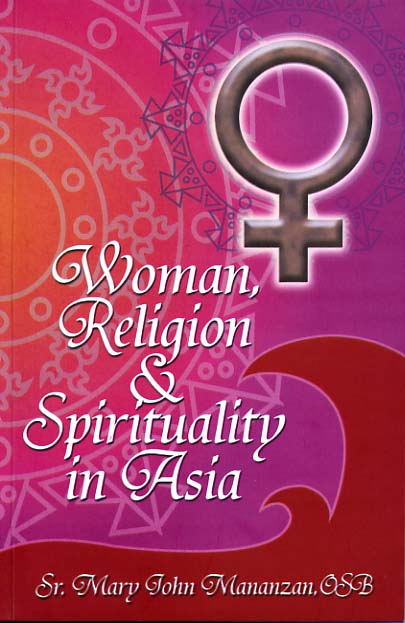 Book Feature:
Women, Religion and Spirituality in Asia by Sr. Mary John Mananzan, OSB
Published 2004 by Anvil and Institute of Women's Studies
ISBN 971-27-1495-0 (bp)
ISBN 971-27-1513-2 (np)
Book Design by Arnold R. Ramos
(click image for detail)
Table of Contents
Perspectives
Chapter 1
Introduction: My Story
A Personal Perspective
Chapter 2
The Asian Feminist Theology of Liberation: A Historical Perspective
Women in Asian World Religions
Chapter 3
Asian Women and Christianity
A Feminist Theological Perspective
Chapter 4
The Basics of Hinduism
Chapter 5
Women in Hinduism
Portraits and Issues
- Portrait One: Kali-Durga
- Portrait Two: Mirabai (1948-circa 1540)
- Contemporary Interview: Madhu Khanna
- Issue Focus: Dowry Deaths
Chapter 6
The Basic Teachings of Buddhism
Chapter 7
Women in Buddhism
Portraits and Issues
- Portrait One: Tara
- Portrait Two: Yeshe Tsogyal, Tibetan Tantric Music
- Contemporary Interview: Chatsumarn Kabilsingh
- Issue Focus: Women's Ordination in Theravada Buddhism (Sri Lanka and Thailand)
Chapter 8
Basic Tenets of Islam
Chapter 9
Women in Islam
Portraits and Issues
- Portrait One: Aisha Bint Abi Bakr Siddique
- Portrait Two: Rabi'a Al-'Adawiyya of Basra
- Contemporary Interview: Norani Othman
- Issue Focus: Polygamy in the Malaysian Context
Women in Non-World Religions in Asia
Chapter 10
Women in Confucianism
Chapter 11
Women in Indigenous Religions
Chapter 12
Women in New Religions of Japan: Tentrikyo
Chapter 13
Women in Folk Religions
Chapter 14
Summary, Appraisal, Conclusion
Bibliography
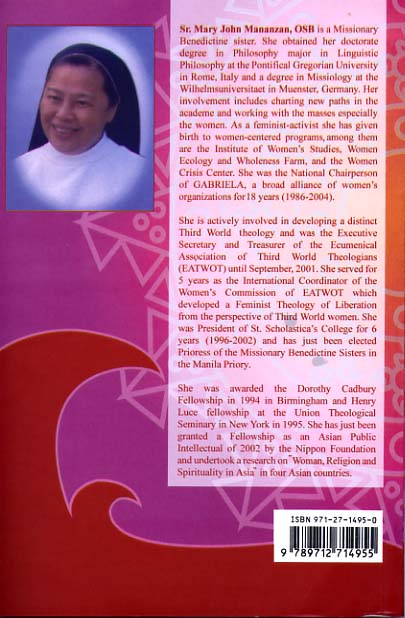 Back cover & About the Author (click image for detail)
Women, Religion and Spirituality in Asia
Event in New York City:
A Roundtable Discussion with Sr. Mary John Mananzan, OSB
When:Thursday, November 10th, 6:30-8:30 pm
Location:
Barnard College, Held Auditorium (304 Barnard Hall)
3009 Broadway, btwn 116 & 120 Sts.
New York, New York
Directions:
Take the uptown 1 train to 116 St / Columbia University. Exit on the west side of Broadway. Enter through the main gate. Barnard Hall is the building directly in front of you.
Hosted by: the volunteer publishers of NewFilipina.com
Entrance: $5
Description:
Come and join Sister MJM in a presentation and discussion about how the scriptures and writings of religions speak of women in Asia and what is the impact of institutional religions on these women. And also includes how women theologians are trying to change what is oppressive while enhancing that which contributes to the full humanity of women. Will also include some discussion on spiritual activism, decolonization and what babaylanism means to Filipino women leaders today. (Babaylan is the visayan word for the village priestess of Philippine pre-colonial times).
About Our Guest Speaker:
Sr. Mary John Mananzan, OSB is a Missionary Benedictine sister. She obtained her doctorate degree in Philosophy major in Linguistic Philosophy at the Pontifical Gregorian University in Rome, Italy and a degree in Missiology at the Wilhelmsuniversitaet in Muenster, Germany. Her involvement includes charting new paths in the academe and working with the masses especially the women. As a feminist-activist she has given birth to women-centered programs among them are the Institute of Women's Studies, Women Ecology and Wholeness Farm, and the Women Crisis Center.
She was the National Chairperson of GABRIELA, a broad alliance of women's organization for 18 years.(1986-2004) She is actively involved in developing a distinct Third World Theology and was the Executive Secretary and Treasurer of the Ecumenical Association of Third World Theologians (EATWOT) until September, 2001. She served for 5 years as the International Coordinator of the Women's Commision of EATWOT which developed a Feminist Theology of Liberation from the perspective of Third World women. She was President of St. Scholastica's College for 6 years (1996-2002) and has just been elected Prioress of the Missionary Benedictine Sisters in the Manila Priory.
Today, Sister is now the Mother Prioress, St. Scholastica's Priory, the Director of Institute of Women's Studies, St. Scholastica's College, Manila, Philippines, Lifetime Honorary Chairperson of GABRIELA, Philippines She was awarded the Dorothy Cadbury Fellowship in 1994 in Birmingham and Henry Luce Fellowship at the Union Theological Seminary in New York in 1995. She has just been granted a Fellowship as an Asian Public Intellectual of 2002 by the Nippon Foundation and undertook a research on Woman, Religion and Spirituality in Asia in four Asian countries. Her book entitled Woman, Religion and Spirituality was published by Anvil and was launched during the International Book Fair at the World Trade Center in Manila on August 15, 2004.
Contact:
Perla Daly
Founder, NewFilipina, Inc., www.newfilipina.com
Chairwoman, FAWN2005, www.fawn2005.com
cel 203.770.7530, studio 860.350.2535
Wednesday, August 10, 2005
Pictures shared by Leny Strobel!
From the Babaylan Symposium, St. Scholastica's College, Manila, July 22, 2005

above: Evelie and Agnes (on the right); I think the woman in pink is Ms Atienza...from a women's NGO (click image for large version)

above: with Senator Leticia Shanani (in native dress); Grace Nono in purple, and Sister Datung (nun)(click image for large version)

above: With Carolyn Brewer and Fe Mangahas and Sister Mary John (click image for large version)
From the Babaylan Symposium, St. Scholastica's College, Manila, July 22, 2005
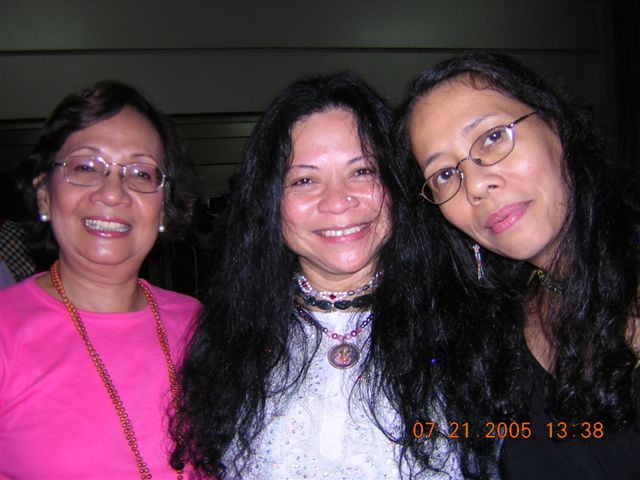
above: Evelie and Agnes (on the right); I think the woman in pink is Ms Atienza...from a women's NGO (click image for large version)
above: with Senator Leticia Shanani (in native dress); Grace Nono in purple, and Sister Datung (nun)(click image for large version)

above: With Carolyn Brewer and Fe Mangahas and Sister Mary John (click image for large version)
Tuesday, August 09, 2005
Babaylan: She Dances in Wholeness
You can now download the Keynote Address of Agnes N. Miclat-Cacayan from the Babaylan Symposium held at St. Scholastica's College, Manila, on July 22, 2005. Thank you Agnes for sharing this with all of us online!
>>Click here to download.
You can now download the Keynote Address of Agnes N. Miclat-Cacayan from the Babaylan Symposium held at St. Scholastica's College, Manila, on July 22, 2005. Thank you Agnes for sharing this with all of us online!
>>Click here to download.
Sunday, June 12, 2005
Mga Kathang Babaylan: Five Book Showcase
Sponsored by the Philippine Expression Bookshop at FAWN2005
Readings and Book Signings with launching of Leny Strobel's A Book of Her Own, Words and Images to Honor the Babaylan.
Readings by:
• Marivi Soliven Blanco (Speak Up, Woman)
• Edwina Bergano, Veronica, Salcedo, Joan May Cordova (FANHS' In Our Auntie' Words: The Filipino Spirit of Hampton Roads)
• Patria Rivera (Puti/White)
• Janet Stickmon (Crushing Soft Rubies: A Memoir).
Moderator: Bino A. Realuyo, (Author of Umbrella )

L to R: Janet Stickmon, Edwina Bergano, Patria Rivera, Marivi S, Blanco, Bino Realuyo(facilitator), Joan May Cordova, Leny Strobel. (not in picture: Veronica Salcedo)
Philippine Expressions Bookshop
The Mail Order Bookshop Dedicated to Filipino Americans in Search of their roots.
2114 Trudie Drive, Ranchos Palos Verdes, CA 90275-2005
telephone 310.514.9139, fax 310.514.3485, Email: lindanietes@sbcglobal.net
Readings and Book Signings with launching of Leny Strobel's A Book of Her Own, Words and Images to Honor the Babaylan.
Readings by:
• Marivi Soliven Blanco (Speak Up, Woman)
• Edwina Bergano, Veronica, Salcedo, Joan May Cordova (FANHS' In Our Auntie' Words: The Filipino Spirit of Hampton Roads)
• Patria Rivera (Puti/White)
• Janet Stickmon (Crushing Soft Rubies: A Memoir).
Moderator: Bino A. Realuyo, (Author of Umbrella )
L to R: Janet Stickmon, Edwina Bergano, Patria Rivera, Marivi S, Blanco, Bino Realuyo(facilitator), Joan May Cordova, Leny Strobel. (not in picture: Veronica Salcedo)
Philippine Expressions Bookshop
The Mail Order Bookshop Dedicated to Filipino Americans in Search of their roots.
2114 Trudie Drive, Ranchos Palos Verdes, CA 90275-2005
telephone 310.514.9139, fax 310.514.3485, Email: lindanietes@sbcglobal.net
Saturday, June 11, 2005
Babaylan Spirit Retreat
presented by FAWN2005 presents
Held the day before the FAWN2005 conference, we gathered together to create sacred space and time. To center and reconnect ourselves with higher purpose and our indigenous spiritual heritage. And also for focusing the energy and intentions of the next days' gathering of Filipino women leaders from around the world. This was a special opportunity to come together to pray, meditate and contemplate on the many levels of where we come from, who are we, what do we want for not only ourselves but also for our families, our communities, Filipinos and humanity.
Click here for the complete gallery

L to R: Potri, Baylan, Rowena, Letty, Joanie, Evelie.

L to R: Ann, Letty, Potri, Baylan, Rowena, Evelie .


Held the day before the FAWN2005 conference, we gathered together to create sacred space and time. To center and reconnect ourselves with higher purpose and our indigenous spiritual heritage. And also for focusing the energy and intentions of the next days' gathering of Filipino women leaders from around the world. This was a special opportunity to come together to pray, meditate and contemplate on the many levels of where we come from, who are we, what do we want for not only ourselves but also for our families, our communities, Filipinos and humanity.
Click here for the complete gallery
L to R: Potri, Baylan, Rowena, Letty, Joanie, Evelie.
L to R: Ann, Letty, Potri, Baylan, Rowena, Evelie .
Friday, June 10, 2005
Spirit of the Babaylan Exhibit
presented by FAWN2005
Coordinated by Marv Velando. Presented by FAWN2005
Click here for more details.
Spirit of the Babaylan: Open Art Exhibit, a pioneer indoor art exhibition organized by the Filipino American Women’s Network Conference on behalf of NewFilipina, Inc. and Philippine Forum, opened on June 2 and ran through June 24. This all encompassing multi-media exhibition – the first of its kind in New York City to date - featured new and emerging work from nine Filipina American artists:
Works of art from this eclectic group of Filipina American artists graced Kimmel Center’s Commuter Gallery to complete an ethereal transformation and usher the viewer into the Spirit of the Babaylan, its different dimensions in contrast with the realities of being a woman and an ancient spiritual and cultural legacy unique of those who know the Philippines as Motherland.
The Kimmel Center Commuter Gallery, located on the second floor of the Helen and Martin Kimmel Center for University Life, New York University's new hub of campus activity for undergraduate students, graduate students, faculty, staff and alumni, overlooks Washington Square Park in the heart of Manhattan’s Greenwich Village.
Click here for more details

Click picture to view movie clip ,courtesy of Mary Ann Ubaldo.
Opening ritual and Song performed by Evelie Delfino Sales Posch.
Click here for gallery of pictures.
Coordinated by Marv Velando. Presented by FAWN2005
Click here for more details.
Spirit of the Babaylan: Open Art Exhibit, a pioneer indoor art exhibition organized by the Filipino American Women’s Network Conference on behalf of NewFilipina, Inc. and Philippine Forum, opened on June 2 and ran through June 24. This all encompassing multi-media exhibition – the first of its kind in New York City to date - featured new and emerging work from nine Filipina American artists:
- Perla Daly
- Madonna Davidoff
- Dulcie Dee
- Valerie Jelski
- Christine Quisumbing Ramillo
- Kinding Sindaw
- Sabrina Alcantara-Tan
- Maryann Ubaldo
- Marv Velando
Works of art from this eclectic group of Filipina American artists graced Kimmel Center’s Commuter Gallery to complete an ethereal transformation and usher the viewer into the Spirit of the Babaylan, its different dimensions in contrast with the realities of being a woman and an ancient spiritual and cultural legacy unique of those who know the Philippines as Motherland.
The Kimmel Center Commuter Gallery, located on the second floor of the Helen and Martin Kimmel Center for University Life, New York University's new hub of campus activity for undergraduate students, graduate students, faculty, staff and alumni, overlooks Washington Square Park in the heart of Manhattan’s Greenwich Village.
Click here for more details
Click picture to view movie clip ,courtesy of Mary Ann Ubaldo.
Opening ritual and Song performed by Evelie Delfino Sales Posch.
Click here for gallery of pictures.
Wednesday, June 08, 2005
Book of Her Own: Words and Images to Honor the Babaylan
 Leny Strobel's Book of Her Own: Words and Images to Honor the Babaylan is a mosaic of poems, reflections, found texts, essays, and images that attempts to answer the question: what do you do after you decolonize?
Leny Strobel continues her research and insight on the process of decolonization, which she first wrote about in Coming Full Circle. In this book, she maps her journey and writes of her unfolding realization that her life need not be overdetermined by dualisms and ideologies; that it is possible to live a joy-filled and peaceful life while always acting with others in the daily constant struggle to be human.
She acknowledges, with a great depth of gratitude, the revolutionary spirit and wisdom of the Filipina Babaylan whose legacy continues to inspire today. That spirit fills these pages.
Book images and illustrations courtesy of Christina Quisumbing Ramilo, ISIS International Manila art by artists Sandra Torrijos, Maica Delfino and Lillette de Lara, Cal Strobel, Tiboli Publishing, Melissa Nolledo-Christoffels, and Celia at <http://desarapen.blogspot.com>.
Cover and art production by Perla Paredes Daly, NewFilipina, Inc.
Table of contents and more details >>GO. OR go to Amazon.com and order your own copy now! Click here.
Publisher: T’Boli Publishing, San Francisco, CA 94134. Email: tiboli@comcast.net
ISBN: 1-887764-64-X
Also order directly from:
Philippine Expressions Bookshop
The Mail Order Bookshop Dedicated to Filipino Americans in Search of their roots.
2114 Trudie Drive, Ranchos Palos Verdes, CA 90275-2005
telephone 310.514.9139, fax 310.514.3485, Email: lindanietes@sbcglobal.net
Book Launch: June 3, 2005.
Sponsored by FAWN2005 and Philippine Expressions Bookshop in New York City.

L to R: Leny Strobel, Sr. Mary John Mananzan and Joan May Cordova at the FAWN2005 conference.

Perla Daly and Leny Strobel
More details on FAWN2005 book event and enjoy pictures at the FAWN2005 Gallery.
Wednesday, June 01, 2005
Walking the Path of the Babaylan

The Babaylan knows very well that all things, all people, all existences are connected.
This is Sacred Internconnection which, in Filipino, is called pakikipagkapwa.
In the end, babaylan is merely a word. It is what it means that it is essential. The role and title of Babaylan carries with it great meaning and great service only in the sense that such leadership involves great responsibility.
We hope you benefit from discussing babaylan leadership in this conference in that you will make better decisions from moment to moment, and that you can better face head-on your personal challenges and, too, the challenges of our world.
For the sake of those we love.
And for the sake of those generations that we will never meet.
From the program of the FAWN2005 Conference, page 8. Click here for PDF excerpt from that program.
Subscribe to:
Posts (Atom)